
Breaking down the term 'artificial overtake' – and comparisons with F1's previous turbo era
 Originally published by Autosport.com
Autosport's recent exclusive interview with Formula 1 CEO Stefano Domenicali generated many responses, some of the most energetic of which were directed at the issue of whether overtaking has become a case of quantity over quality under the latest technical regulations.
"Some people are saying it is artificial," he said. "What is artificial? Overtaking is overtaking.
"And people have a short memory because in the turbo age in the 1980s – I was already following quite well Formula 1 – the lift-and-coast using different turbo, different speed and you have to save in racing because otherwise the fuel tank was too small.
"Maybe some of the people are criticising or having some comments have a short memory. So look back in the 80s, the turbo time, these things were there."
There is much to unpack in this handful of sentences. Immediately after the opening grand prix of the season in Australia, F1 was keen to promulgate the sheer number of overtaking moves versus the previous year via its social channels – and the response was so negative that it has been rather more cautious since then.
Nevertheless, the official line remains that more is better, regardless of the widespread school of thought that the 'yo-yo racing' triggered by different levels of available boost is fundamentally meaningless.
The question of available boost and energy management plays into the separate-but-related topics of where drivers are having to lift and coast, or even engage in super clipping, to manage charge – and how that affects both the spectacle and safety.

The 2026 Australian GP had 120 overtakes, compared to 45 in 2025
Photo by: Sam Bloxham / LAT Images via Getty Images
In Japan, few were impressed by the sight of 130R, once among the more daunting challenges in grand prix racing, becoming little more than a glorified charging station. The disparity in closing speeds which triggered Oliver Bearman's shunt also gave pause for thought.
There is an argument – one which Autosport put forward for debate before the start of the season – that nostalgia presents a sanitised and heavily confirmation-biased picture of the past. For most of the world championship's history, drivers have had to be managing something during races, and aren't necessarily always flat out.
But at the nub of what many fans find discombobulating and unsatisfactory about the current ruleset is the uncontested nature of many of the overtaking moves. Lots of cars passing one another – but what's the story? Where's the struggle against the odds?
Where, indeed, is the moment where a supremely gifted and brave driver conjures something out of nothing?
One driver who has pulled off some of the most audacious passes of the television era is Nigel Mansell, world champion in 1992 and a contender for the title when the 1980s turbo era was at its peak.
True or false
Mansell was also doing the rounds in the press last week, in his role as ambassador for and special guest of the Pop-Up Hotel at Silverstone, which overlooks the site of one of his most memorable overtaking manoeuvres in F1: the Hangar Straight and Stowe corner, where Mansell blitzed past Williams team-mate Nelson Piquet to win the 1987 British Grand Prix.
"I might get shot for saying this," he told Autosport. "But, sadly, some of the overtakes are just totally false. I mean, some of the overtakes look great and then you come out the next corner and the car just blasts past you - the other car goes backwards - because the computer's giving you the extra power not at the right time.
"The driver doesn't control that, obviously, because he wouldn't have employed it. I think it was Lando [Norris] who was quoted, ‘Well, I didn't want to overtake him [Lewis Hamilton in Japan] going into the fast corner, into the chicane. But I had no choice, you see.'
"Coming out of the corner, he's in the lead and then the other car [Hamilton] just blasts past him again. Going down the straight. So, I think you've got to be very careful.
"Because – forget me, it doesn't matter about me, but the fans around the world, I know an awful lot of them, are very grumpy and, to be fair to the fans, I agree with them."

The reigning world champion expressed frustration in Japan that his battle with Hamilton was disrupted by the effects of software intervention
Photo by: Mark Sutton / Formula 1 via Getty Images
Judging the quality of overtaking is always going to involve an element of subjectivity. There will be those who, like the commercial rights holder, take the view that overtaking is overtaking, and the more of it the better.
But this comes across as rather tone deaf and dismissive in the face of such widespread and well-founded criticism. Different cars have always had different performance parameters, yes, but the underlying dramatic value of any sporting spectacle hinges on whether the moment was ‘earned' or not. An overtaking manoeuvre executed with guile, skill and bravery will resonate more than one determined by a machine-learning algorithm and a battery.
It's fair to say that the addition of each car's ‘state of charge' to the F1 TV graphics has been useful to our understanding of events as they play out before us, but they do not make the heart beat faster.
Speak to any F1 fan of a certain vintage and they could probably name, off the top of their head, some of the greatest overtaking moves pulled off by Mansell – to name but one eminent historic driver. Swooping around the outside of Gerhard Berger, seemingly in defiance of the laws of physics, at the Peraltada in Mexico in 1990. Wheel to wheel with Ayrton Senna at Barcelona in 1991. Piquet at Silverstone in 1987. Boxing in Senna behind Stefan Johansson's Onyx to grab the lead in Hungary in 1989.
While the opening grands prix of 2026 have, on the face of it, been action-packed, much of the trading of places has been determined by battery levels rather than bravura. Interestingly, the so-called ‘energy-poor' tracks – Albert Park and Suzuka – have been the most blighted by ‘fake' overtaking, though there have been exceptions such as Charles Leclerc's dismissal of George Russell in Japan.
In China, where the big stop at Turn 14 and the tightening radius of Turns 1-2-3 placed more emphasis on driver judgement, much of the action felt less superficial.

The 1987 British GP, where Mansell broke the Silverstone lap record several times during his hunt of Piquet in the latter stages
Photo by: Motorsport Images
F1 claims a substantial proportion of the audience shares its opinion that any overtaking is good overtaking – although it has yet to present data to support this.
Much of the fanbase is left cold unless the overtaking is determined by a driver seizing the moment, and commanding the power by their right foot, rather than the intervention of some heuristic byte-juggler. There is ample evidence of this in Autosport's inbox, the responses on social media, and the comments on our website and YouTube channel.
We (don't) have lift-off
So, beyond the matter of whether "overtaking is overtaking", is the lift-and-coast comparison with the 1980s really the mic drop the apologists for the present regulations think it is?
Again, there are parallels with the present day in that energy management became a facet of the competition – mainly because tighter fuel tank capacity was one of the levers the FIA pulled to rein in turbo performance, along with limits on maximum boost. But it's not a like-for-like comparison, as Mansell made clear when Autosport put to him the claim that drivers also lifted and coasted in the 1980s.
"No, we didn't," he said, repeating his position for emphasis. "No, no, we didn't. If you lifted and coasted, it was like feathering. Feathering a throttle when you're slipstreaming somebody and deciding not to overtake them, that's saving fuel and feathering. That's smart.
"Having to have a computer just take over the running of the car and harvest for the battery, that's something totally different. And we didn't slow down 50 to 70km/h going into the fastest corners. So, it's a bit of a stretch to compare that, I have to say."

Mansell denies that lift and coast was a big thing in the '80s
Photo by: Glenn Dunbar / Motorsport Images
Obviously there was no hybrid system on the cars during the 1980s, so no electric motor to charge the battery through magnetic resistance. Then, lifting off would purely have been to save fuel rather than harvesting energy.
Where the comparison begins to fall down is the relative crudity of the fuel calculations during the 1980s. This was an era when the fuel injection pumps were usually powered by the engine's camshaft, as were the metering units.
Under the 220-litre tank, no-refuelling rules introduced in 1984, McLaren dominated – partly because its Porsche-built TAG V6 turbo was the most fuel-efficient on the grid, if not the most powerful, because race pace had been the key development benchmark rather than peak qualifying power. Nevertheless, the team was bedevilled by difficulties with the advanced Bosch Motronic engine management system.
In this era, fuel saving was much more haphazard, determined by engineers calculating the rate of burn ahead of the race and then handing their drivers a target pace, which may or may not have been correct, even if the drivers chose to follow it. Short-shifting under acceleration was the chief fuel-management tactic aside from turning down the turbo boost pressure, along with ‘feathering', while for most lift-and-coast was a measure of last resort if the cars began to splutter in the closing laps.
Pore through the results of 1980s grands prix and you will find countless examples of late retirements caused by running out of fuel. This is chiefly because tools to give real-time indications of how much remained on board didn't exist until the middle of the decade – and even then, they weren't always very accurate.
Let's take the famous example of the 1985 San Marino Grand Prix, in which 25 cars started but only seven were running on the final lap – six if you discount Thierry Boutsen, who had to push his car over the finishing line and was ultimately rewarded with second place. Seven drivers ran out of fuel, including on-the-road winner Alain Prost, who halted on the cool-down lap and was disqualified when his car was found to be underweight.
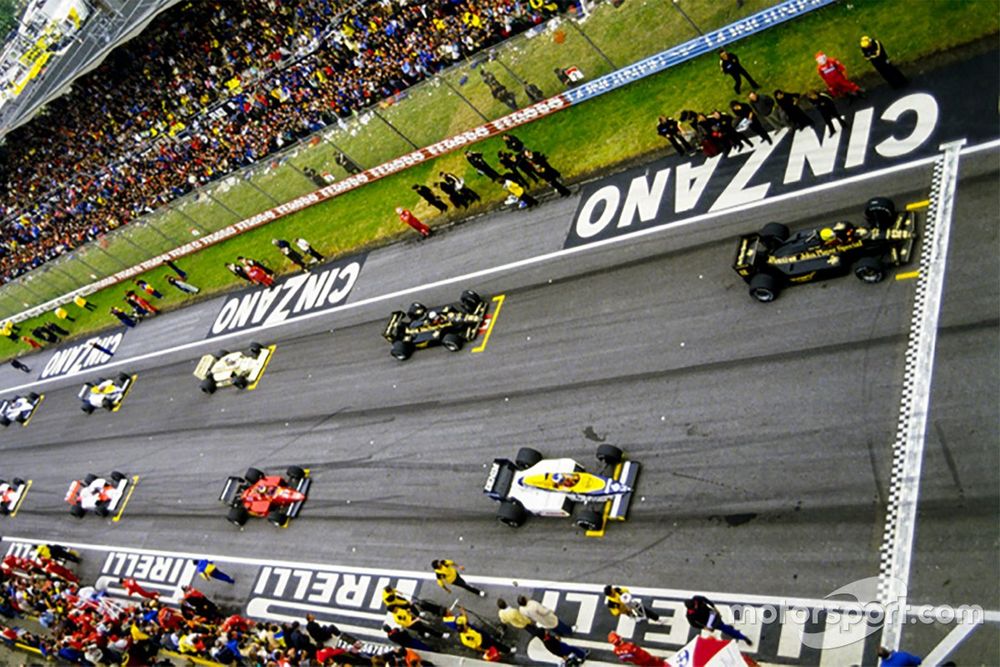
Almost the entire grid ran out of fuel at Imola in 1985
Photo by: Motorsport Images
Senna led much of the race in his Renault-powered Lotus, only to run out of fuel four laps from the chequered flag. Piquet (Brabham-BMW), Stefan Johansson (Ferrari), Mansell, and Prost's team-mate Niki Lauda also halted with dry tanks. Johansson actually inherited the lead from Senna and his fuel readout continued to insist there was plenty in the tank even as his engine began to splutter on its dregs.
Prost had been fuel-saving throughout after dropping away from an early battle with Senna. "Bosch were developing the system to work out exactly how much fuel we were using and we knew Imola was going to be tight anyway," Prost's race engineer Tim Wright told Autosport in a 2020 retrospective on this grand prix.
"The whole approach to the race was we were going to have to take it fairly easy and just see how things panned out. We were advising Alain of the pace he should be maintaining."
Memory is selective and very few racing drivers would enjoy being described as "taking it easy" during a grand prix, but indubitably fuel saving was a factor in the turbo era after F1 adopted a fixed tank size. Then as now, carrying excess weight brought a laptime penalty, so it was to be expected that teams ran as close to the margins as possible – it's just that back then, the means of measuring the changing load were so much cruder and inexact.
Modern race engineers can tell their drivers exactly where and when to lift off or apply less throttle – although, increasingly, much of this process is being performed by machine-learning software.
Other drivers active in the 1980s, including Sky F1 commentator Martin Brundle, have pointed out that lift-and-coast was an essential part of the toolbox in the limited-fuel turbo era, along with short-shifting and dialling down boost pressures. Were they doing it lap-in, lap-out, in precise areas, though? Not so much as now.
Application of tactics such as lift-and-coast in the modern era is much more measured and precise, a digital rather than analogue process. You could argue that "advising Alain of the pace" is similar to that modern piece of engineer speak, "driving to a delta".
What's undeniably different, though, is how much of that was determined by the driver's instinct, and their right foot.
We want to hear from you!
Let us know what you would like to see from us in the future.
- The Autosport.com Team