
The Williams FW20: The car that ended an F1 dynasty
 Originally published by Motorsportweek
It is not unfair to call 1998 a turning point for the competitive order of Formula 1. Since 1992, Williams and Renault had ruled the roost in spectacular and dominant fashion at times. The sound of the distinctive Renault V10 engine became as associated with victories as the iconic dark blue liveries of some of the most famous cars in the sport’s history.
Frank Williams led the team through its most successful phase, ably supported by Technical Director Sir Patrick Head and Chief Designer Adrian Newey. Between the three, they created an F1 dynasty that is still revered today, even if the team is currently nowhere near the heights of its once-almost-invincible power. However, like all great dynasties and empires, the end comes, and usually without warning.
1998 marked the end of Williams’ vice-like grip of F1, as the Williams dynasty of dominance came crashing down. To put the team’s decline into context: Williams won the title in 1997 with 123 points. In 1998, it plummeted to third in the standings, scoring just 38 points, compared to 165 scored by champions McLaren, and the first time since 1988 that the team had failed to win a race. The year was by all accounts, a spectacular fall from grace.
Its dethroning did not happen by accident. Rather, multiple causes led to Williams’ downfall. Some were years in the making; others were the result of circumstances. It is not unreasonable to work backwards from today and mark 1998 as the year when the team’s influence and standing on and off-track both ended, from which it has never recovered.
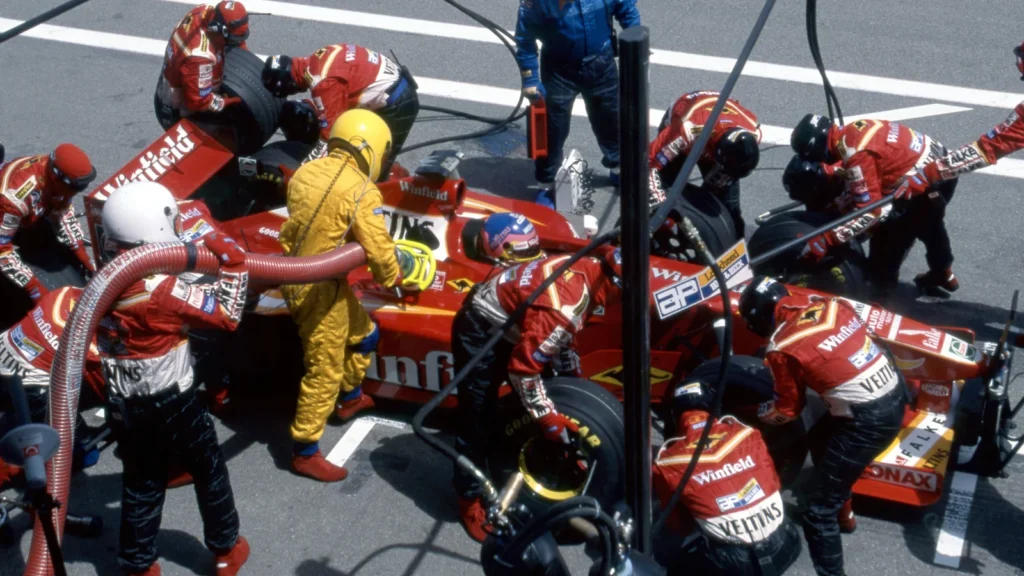
Drivers Jacques Villeneuve and Heinz-Harald Frentzen did the best they could with the FW20, a car that never stood a chance of victory. Hamstrung from the first race, it led to struggles in both performance and internal politics. Frank Williams’ team remains revered today, but in 1998, talk of the paddock was centred on how the Grove marque had failed so spectacularly.
Renault and Newey out at Williams
The first major headwinds facing Williams in the new era of F1 were two of its biggest. Having won 52 races in the last five years and winning the constructors’ title in all of them with Williams (and Benetton in 1995), Renault decided it had nothing left to prove in F1 and opted to bow out at the end of 1997.
Frank Williams opted to continue running the Renault V10 engines in 1998, (along with rivals Benetton), now a year old. Rebadged as Mecachrome, these lacked the development of the works operations of Mercedes and Ferrari and were always destined to fall behind rivals. A BMW works engine supply would give Williams the factory engine partner it lost, but this would not start until 2000. Until then, compromised engines would hold it back.
Exact figures of the horsepower deficit are challenging to quantify to say the least, but it was somewhere in the region of 30 to 50bhp down on the Mercedes V10 that propelled McLaren to championship glory by season’s end. Or, to put it into a more relatable context, a Volkswagen Beetle had escaped from the rear of the FW20.
Another factor that contributed to the decline of the once-dominant team was Newey’s departure for McLaren. That his first car for the Woking marque took the title should give an indication of the void Newey left behind at Grove. Departing on the eve of the 1997 season, Williams immediately faced the consequences of losing Newey, as the dominance of 1996 fell away. It still won both titles, but had to work for it until the very last race of the year.
With no Newey input into the 1997 FW19, it subsequently lost his influence for the all-important 1998 technical regulations changes. As a result, the FW20’s birth came not from one person, but three. Chief Designer Gavin Fisher and Head of Aerodynamics Geoff Willis joined Head in the endeavour, resulting in a car that Head branded conservative at the start of the season. For the car’s own designer to label it derogatorily is as damning as it gets. It’s a bit like a university professor telling you your failing grade on a paper is due to his own poor marking.
So how did Sir Frank Williams lose F1’s most influential designer ahead of 1997, dooming it to terminal decline? One reason and one reason only: politics. Frank Williams demanded total control of his operation, with Head owning a controlling stake. Newey had slowly increased his influence at Williams and wanted a stake in the team, something Frank Williams vehemently refused to give.
Instead, he had clauses in his contract stipulating he had a say in major decisions, including driver lineups. But having been ignored on concerns over Mansell’s departure, not being consulted over Villeneuve’s signing in 1995, discovering that Frentzen would replace Hill at the end of 1996 proved to be the final straw. Frank Williams would call Newey’s departure the biggest regret of his career.
A major reality check
Pre-season testing is usually a time of excitement, doubly so at the start of a new F1 regulations cycle. The cars were now narrower, with grooved tyres and a much larger crash structure on the sides to comply with enhanced side-impact tests. For the FW20, the design trio chose to evolve the successful FW19 for the new rules. Executing this several times in the past, it seemed a logical move.
But as F1 pre-season testing began, the true scale of Williams’ fall from grace became apparent. Drivers are aware within a few laps if their challenger for the year ahead is a good one or not, with Villeneuve quick to discover his fate. It became apparent instantly that the FW20 was a major step backwards in every area, hindered by a year-old Renault engine with limited development opportunities.
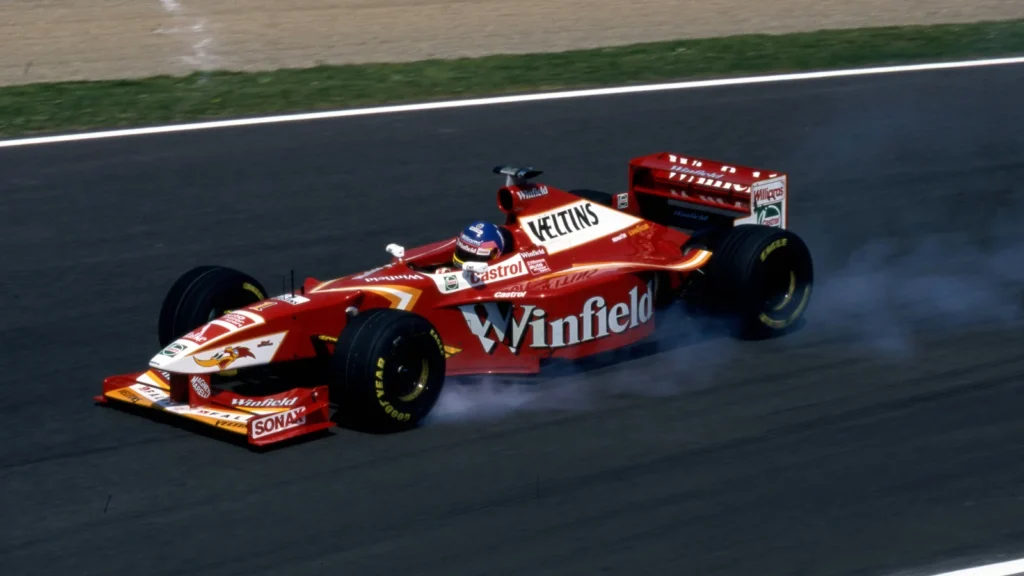
The Canadian described the car as “not a winner”, hindered by constant mechanical gremlins as the team aimed to understand its new challenger. The combination of grooved tyres, outdated horsepower and a conservative evolution of the previous year’s regulations had left Williams with an impossible deficit to McLaren and Ferrari ahead of the season opener. The car also had a dramatic new look: a light red to mark the change of title sponsor, as parent company Rothmans International pushed its Winfield brand. To say Frank Williams did not like the new colour scheme is putting it mildly. It also failed to bring speed.
To understand just how far the once invincible team had fallen, one only has to look at qualifying for the season opener in Australia. On pole in 1997, Villeneuve had to settle for fourth on the grid, a whopping 2.5 seconds away from polesitter Mika Hakkinen’s McLaren. A gulf that rivalled a Ballerina at the Royal Albert Hall performing on the same stage as a drunk man on a lads stag night out in Europe, an embarrassing start to F1 in 1998 was all but guaranteed for Williams.
Villeneuve and Frentzen were lapped during the race, an unthinkable situation just a year before. While Frentzen took third, it was a poor consolation prize, with world champion Villeneuve forced to defend fifth from a fast Johnny Herbert in the Sauber. Williams was no longer the top dog; if anything, it had become a lame pup. The Mecachrome power deficit was immediately obvious on the straights, and Villeneuve complained of poor grip and handling.
The next two races provided slim reasons to be hopeful; if anything, the gap widened. The FW20 had now become a midfielder, battling the likes of Benetton and Jordan for a consolation prize of “best of the rest”. Frentzen took a fifth in Brazil, while Villeneuve failed to score. Argentina showed promise, with Villeneuve running inside the points, but a collision with Coulthard’s McLaren spun him out of the race. The gap had increased again by Spain, qualifying a dismal tenth and 13th having taken pole position the year before.
A champion demanding a better car
With Ferrari and McLaren out of reach, the odd fourth and fifth places were the best the Williams could hope for. While allowing the team to regain some minor composure, Mecachrome power left the drivers some 40 seconds or above adrift of the McLarens and Ferraris.
By now, world champion Villeneuve had become as disenfranchised as a modern Star Trek fan and had begun to publicly rebuke Williams for its astronomical miscalculation with the FW20. But far from being all talk and no action, the reigning world champion had begun early talks with good friend Craig Pollock to drive for the new British American Racing team that would take to the grid in 1999. Taking over Tyrrell, Pollock, and Villeneuve had bold ambitions. The announcement confirming Villeneuve came mid-season.
In perhaps the most damning indictment of Williams’s decline, the Canadian opted to race for a new team, rather than a declining giant. His reasoning for the move proved as blunt as ever: “At Williams, it’s a factory,” he said. “You are a component. At BAR, we are building a world from scratch. I’d rather be the architect of a new house than a tenant in a crumbling palace.”
Having lost Newey, Frank Williams had now also lost his star driver and had to salvage the rest of his faltering 1998 campaign. But the team got a welcome injection of confidence in terms of results, in the least likely place for a car with a 30 to 50bhp deficit. Those who watched F1 in the 1990s will remember the Hockenheimring with fondness. Miles of straights through a forest, split by a few chicanes. A test of brakes and raw engine power, Renault traditionally did well.
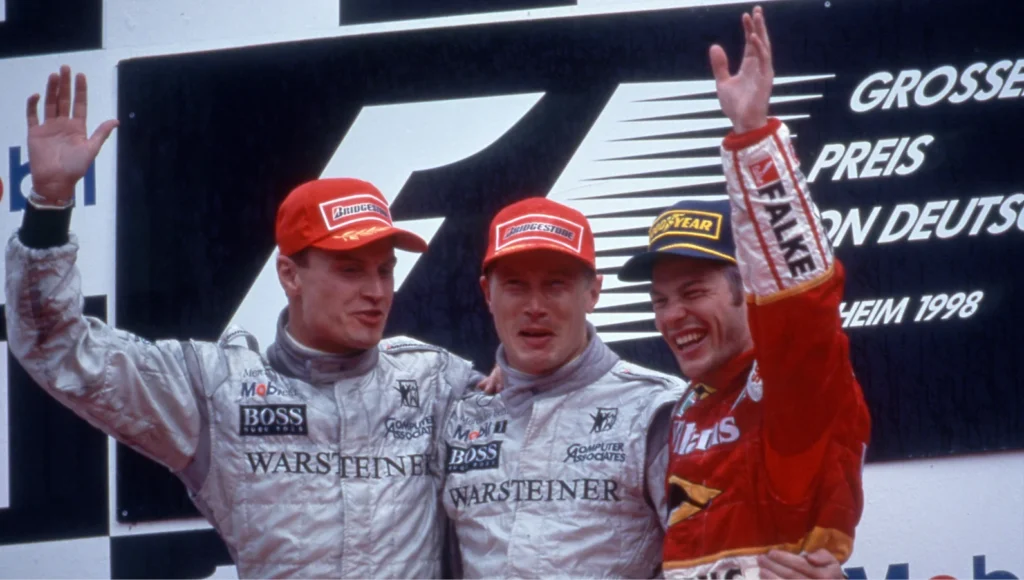
But these engines were now a year old, and the weekend’s prognosis looked bleak. So imagine the shock when Villeneuve qualified in third. The race also gave hope, the FW20 staying in touching distance of the all-conquering McLarens and even pushing them towards the end. He followed this up with another third at the next round in Hungary, albeit, 44 seconds behind winner Schumacher.
Other than a spectacular crash at Eau Rouge in practice, that was exciting as the season got for Williams. To add insult injury, Damon Hill’s Jordan dived down the inside of Frentzen at the last corner of the last lap to steal fourth, infuriating Frank Williams. Frentzen, having not gelled with the management at Grove was dropped, resulting in an all new driver lineup for 1999 in Ralf Schumacher and Alessandro Zanardi.
Sticking out like a sore thumb at the Williams Heritage museum, the red car almost looks like a wannabe Ferrari, without the reputation behind it. The Williams FW20 truly marked the end of an era; it acted as the catalyst that ended a dynasty of excellence in F1.