


McLaren finds hidden edge in Las Vegas as FP2 data uncovered
 Originally published by PlanetF1
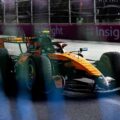
Mercedes topped a wet FP2 in Las Vegas, but the team that left the best impression was McLaren, who brought their tyres up to temperature faster than anyone else despite finishing well off the pace.
Telemetry data reveals why tyre warm-up could decide the Las Vegas Grand Prix, and where Ferrari, Mercedes and Red Bull stand ahead of a dry weekend.
Who looked best on track in Las Vegas?
What makes these opening two practice sessions in Las Vegas unique is that raw lap times are not the primary indicator of performance. The team that left the most positive impression was McLaren, even though both Piastri and Norris ended the session well off the benchmark time set by Russell.
The main reason is that in these tricky conditions, McLaren managed to bring their tyres up to optimal operating temperature the fastest—a factor that will be critical throughout the weekend.
Las Vegas is a low-grip street circuit where cold night-time ambient temperatures lead to low track temperatures, heavily penalising tyre warm-up, especially when combined with long straights that cool the tyres down even further.
The only sections that genuinely help generate heat are the high-speed corners—specifically Turn 6, Turn 10, and Turn 11—where drivers can utilise tyre hysteresis (the compression and expansion of the rubber compound) to effectively build core temperature.
A common phenomenon on low-grip street tracks is that sliding rapidly spikes tyre temperatures, but only on the outer surface layer. This leads to accelerated tyre wear even when overall grip levels remain low.
Consequently, managing this thermal window will be exceptionally challenging, and whichever team solves it best will hold a massive advantage in both qualifying and the race.
We saw this effect in previous years during the ground-effect era, but it could prove even more pronounced now given the lower downforce levels of the 2026 cars and the longer straight-line aero mode compared to last year’s DRS zones.
As noted, in tricky conditions where rain makes tyre warm-up even harder, McLaren looked very strong in this area. Running a new floor specification, Norris was noticeably quicker than the rest of the field immediately upon leaving the garage during the first half of FP2, suggesting the car carries plenty of downforce, particularly over the front axle.
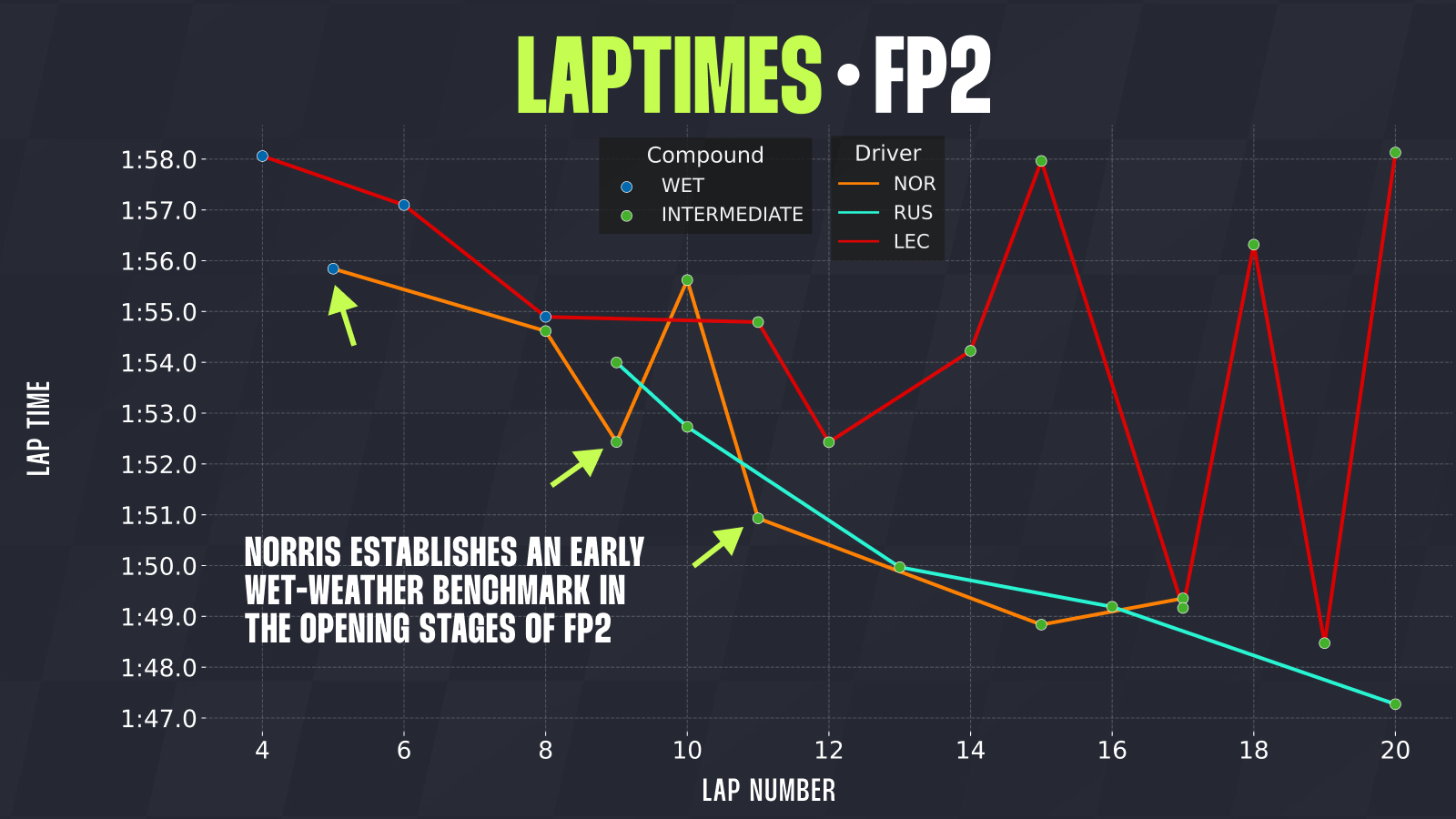
Laptimes scatterplot – FP2
By the end of the session, McLaren had completed fewer laps; as the track dried, rivals improved their times while Norris and Piastri stayed on older marks, yet their underlying work in FP2 was very solid.
Ferrari’s straight-line deficit and Mercedes’ advantage
Another team that showed pace—though one likely to struggle with tyre warm-up compared to McLaren—is Ferrari. Early in FP2, particularly on the full wet blue-walled tyres, they looked like the second-best team on track.
The wet surface initially masked their power unit deficit, but as the circuit dried and speeds rose, that shortfall became increasingly visible. Analysing the fastest laps of Russell and Leclerc reveals just how steep the loss on the straights remains: Leclerc surrendered roughly 0.350 seconds along the longest straight alone.
On the flip side, as we have come to expect, Ferrari excelled in the slow-speed corners, where their advantage over Mercedes was clearly visible.
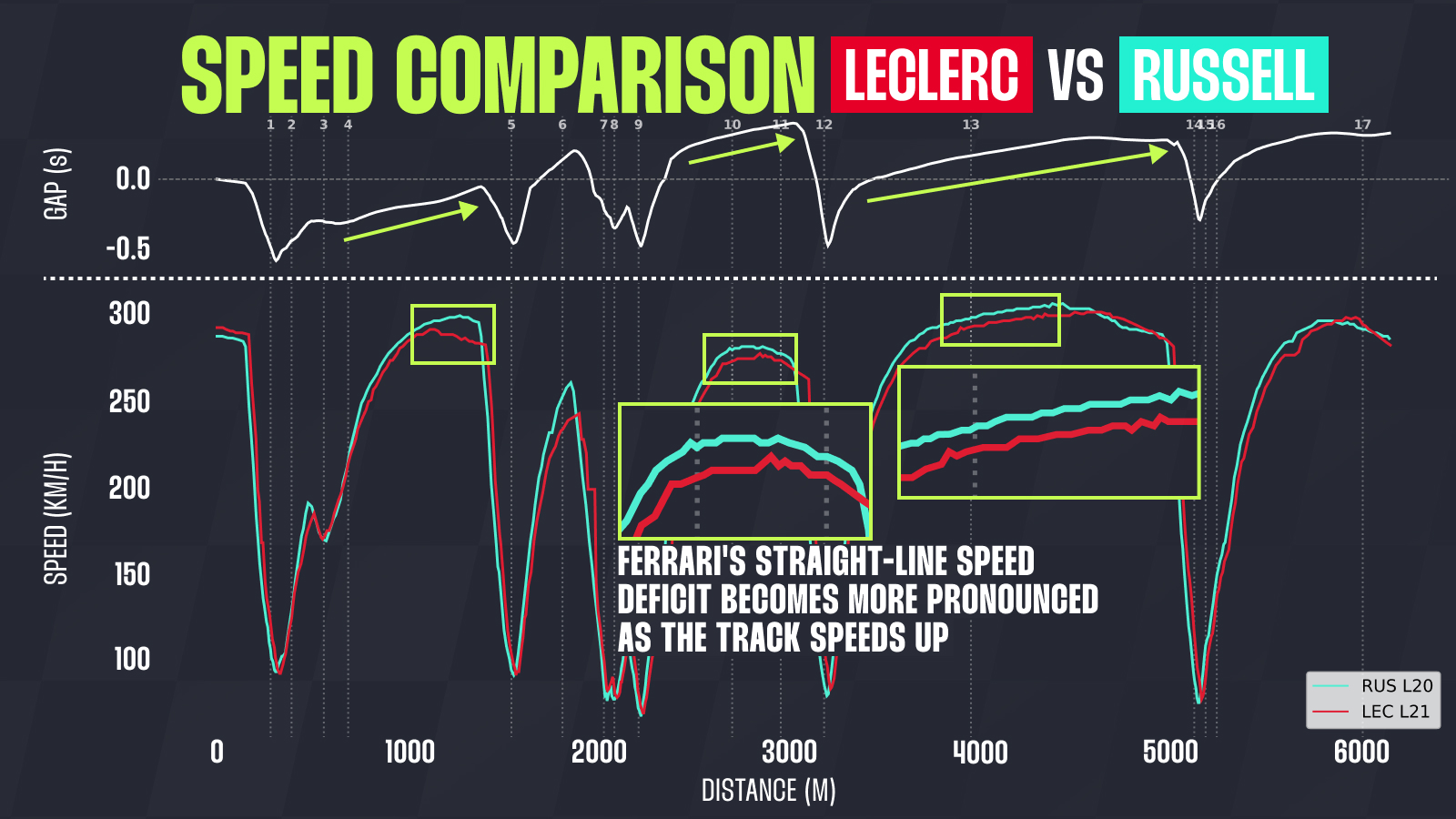
Speed comparisons between Leclerc and Russell in Las Vegas FP2
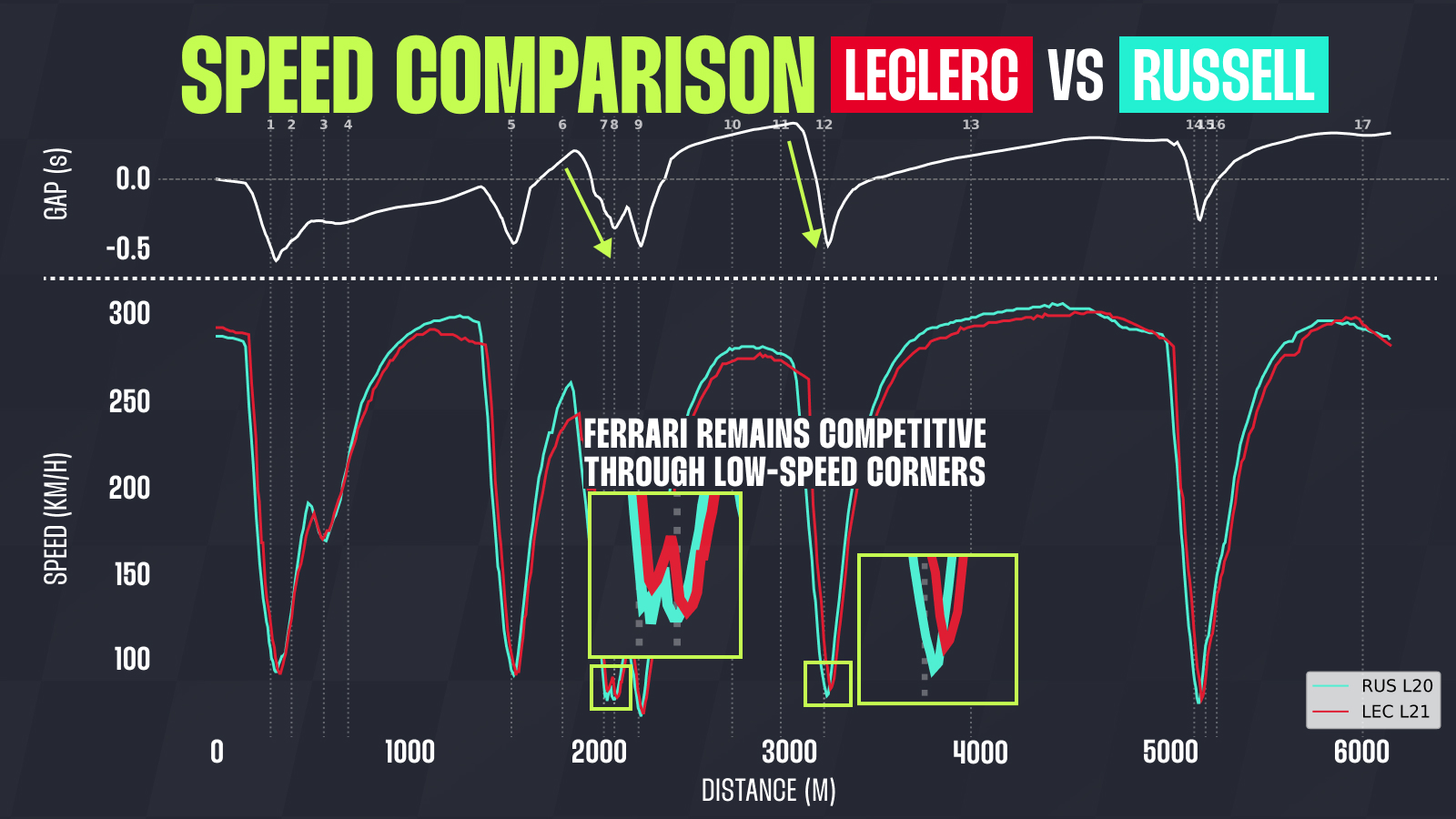
Speed comparisons between Leclerc and Russell in Las Vegas FP2
One mitigating factor for the Maranello squad is that we will very likely see a ERS created 350 km/h speed ceiling on the straights in Las Vegas, much like we did in Mexico. Above this threshold, cars are restricted from using electrical deployment, leaving them relying solely on the 550hp internal combustion engine, which cannot push the car any faster—effectively capping top speed at that figure until the end of the long straight.
While this effect was amplified by thin air and rapid acceleration in Mexico City, cars will still reach this ceiling along the massive Las Vegas Strip straight.
How Free Practice Thursday unfolded in Las Vegas
George Russell steals the show with last-gasp lap in Las Vegas GP FP2
Las Vegas FP1 a wash-out with just 20 laps covered and not a single time set
This may soften the blow slightly for Ferrari, though their deficit in this sector will almost certainly remain noticeable and likely keep Leclerc and Hamilton out of the fight for victory this weekend. In reality, their best chances hinge on wet weather continuing over the remaining two days.
Meanwhile, the team we definitely expect to fight for the podium—and the squad that topped the FP2 timesheets—is Mercedes. Although they were slower in heavy wet conditions on full wet tyres, it is no coincidence that they set the fastest time once the track was at its driest.
Their straight-line advantage will be substantial, further underscored by Pierre Gasly finishing second in FP2 using a Mercedes power unit.
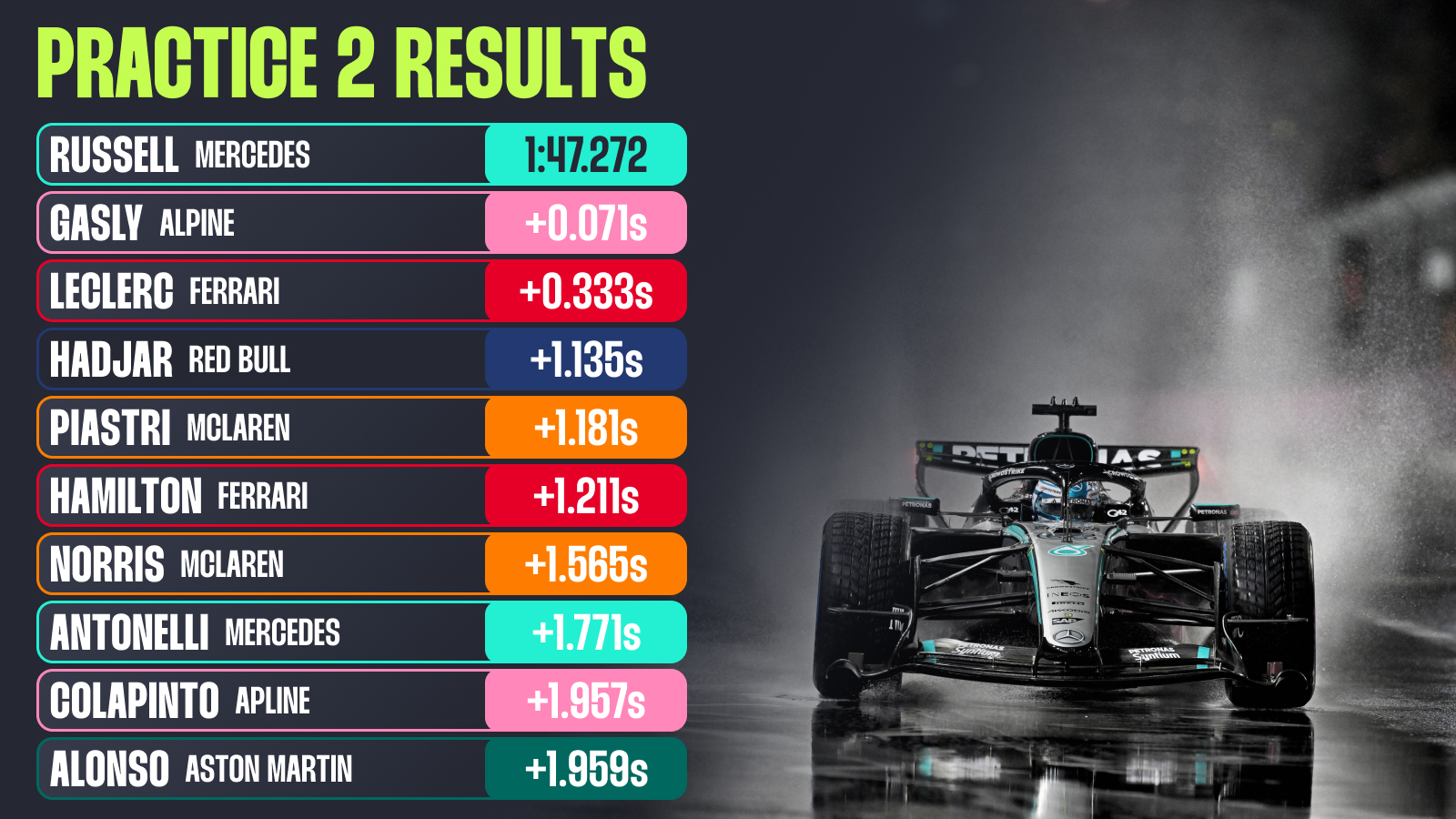
Practice 2 Results
The only team capable of matching them in this area appears to be Red Bull. They endured a subdued start, but we can certainly expect a bounce-back. The wet-weather handling issues we saw in Brazil resurfaced in Las Vegas, clearly disrupting the balance of their car.
With dry weather forecast from FP3 through the rest of the weekend, we should expect a much faster Red Bull; if they dial in their dry setup, they will be right in the hunt for the win.
With a dry track expected moving forward, teams face a complete reset starting in FP3, leaving just a single hour of practice to make setup changes and find the optimal dry-weather balance.
Read next: The Las Vegas Grand Prix will be streamed free in major broadcast change