
FIA: ‘We cannot be hostage to automotive companies’ over F1 engine regulations
 Originally published by Motorsportweek
FIA Single Seaters Director Nikolas Tombazis has revealed a stance from the Formula 1 governing body over the future power of power unit manufacturers.
Heralded by many as the start of a new era, the 2026 power unit regulations took six years of development to sign off, designed to prepare the sport for the future.
Created at a time when governments and car companies were pushing for electrification, the new rules attracted Audi and General Motors, and brought Honda back after its departure in 2022.
But instead of generating excitement, the regulations have proven deeply divisive, with excessive battery management and superclipping seeing cars slowing down on straights.
An accident involving Oliver Bearman and Franco Colapinto in Japan served as the catalyst for planned tweaks ahead of Miami, but concerns remain that these aren’t enough.
Tombazis has also hinted at a change in stance on internal combustion vs electrical power from the governing body. He admitted a change in “the political landscape”, as manufacturers row back on failed efforts to ditch internal combustion entirely.
“Well first of all, it is true, the political landscape has changed,” he said.
“And back when we discussed the current regulations, the automotive companies, who were very involved, told us that they’re never going to make another internal combustion engine again – a new one.
“They were going to phase out, and by whatever year, they were going to be fully electrical, for example. Obviously, this hasn’t happened. That’s not to underestimate the importance of electrification globally, but it didn’t happen as much, as I said.
“Secondly, I think one of the not frequently discussed stories, because it’s not something visible, is that, of course, we did go for fully sustainable fuels, and I think, a reasonably good outcome.”
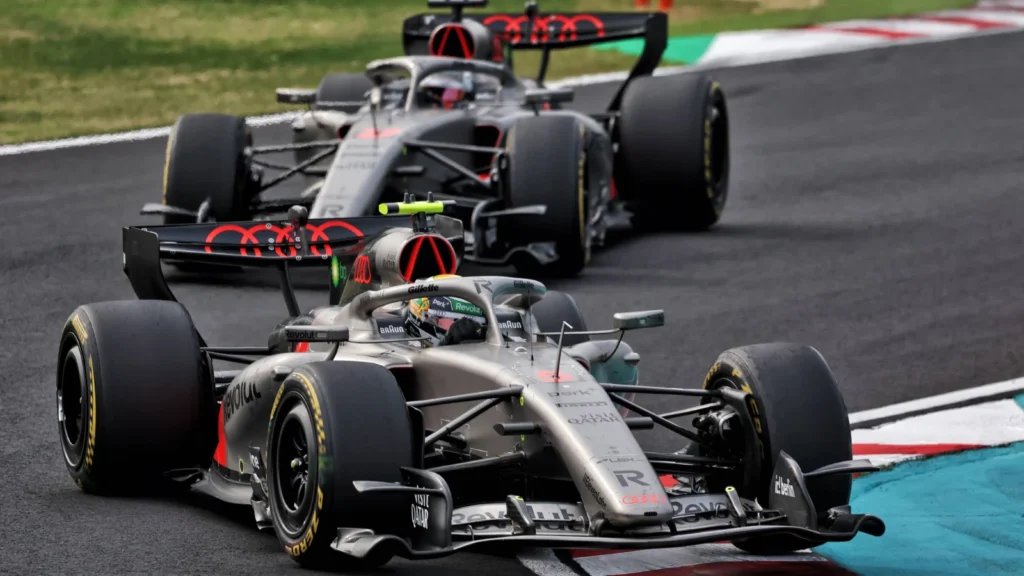
FIA hints at major change of stance towards manufacturers
Tellingly, Tombazis also hinted that engine manufacturers have too much political power, and the governing body will take a new approach to pressures for certain regulations.
“So in terms of where we want to be in the future, we do need to protect the sport from the world macro-economic situation,” he said. “Meaning we cannot be hostage to automotive companies deciding to be part of our sport or not.
“We want them to be part of our sport, absolutely. That’s why we’ve worked so hard to secure new ones to participate.
“But we can also not be in a position where, if they decide they don’t want to be, we’re suddenly left vulnerable. And we need to keep working for cost reduction.”
Tombazis’s hints are the first indication that the FIA could ditch these much-maligned power unit regulations prior to their official phase-out in 2031.
The pressure facing the sport is substantial, and it seems the days of absolute road relevance may be coming to an end.