
Why McLaren will deliver "an entirely new" F1 car in Miami – but expects all rivals to do the same
 Originally published by Autosport.com
Judging and executing in-season development has become one of McLaren's strongest suits in recent Formula 1 seasons, most significantly in 2023 and '24, when it introduced upgrade packages early in the campaign which proved transformative.
So when team principal Andrea Stella used the forum of a special event for select media at McLaren's Woking factory to describe the MCL40 it will bring to Miami as a "new car" – using that phrase not once but twice – he had historic precedent on his side, as well as his reputation for not engaging in vacuous boosterism.
"In our intent there was always the idea to deliver a completely new car," he said. "Especially from an aerodynamic upgrades point of view for the North American races so we could keep up with this plan. Obviously the fact that the calendar has been changed sort of helped a little bit, like I'm sure it helped all the other teams that could work more streamlined towards upgrading the car rather than being busy with racing.
"But I could say overall that across Miami and Canada we will see an entirely new MCL40. Again I would like to stress that this is what I would expect of most of our competitors, so not necessarily is going to be a shift in the pecking order.
"It will be effectively just a check who has been able to add more performance within the same time frame. And we also have some performance to recover if we look at Mercedes and to some extent Ferrari as well, but we are quite happy with the development that we have been able to manage in the background.
"So hopefully we should be able to see a slightly more competitive MCL40 in Miami and then in Canada, considering that the last race was already a decent competitive performance in Japan, so we definitely look forward to the next races."
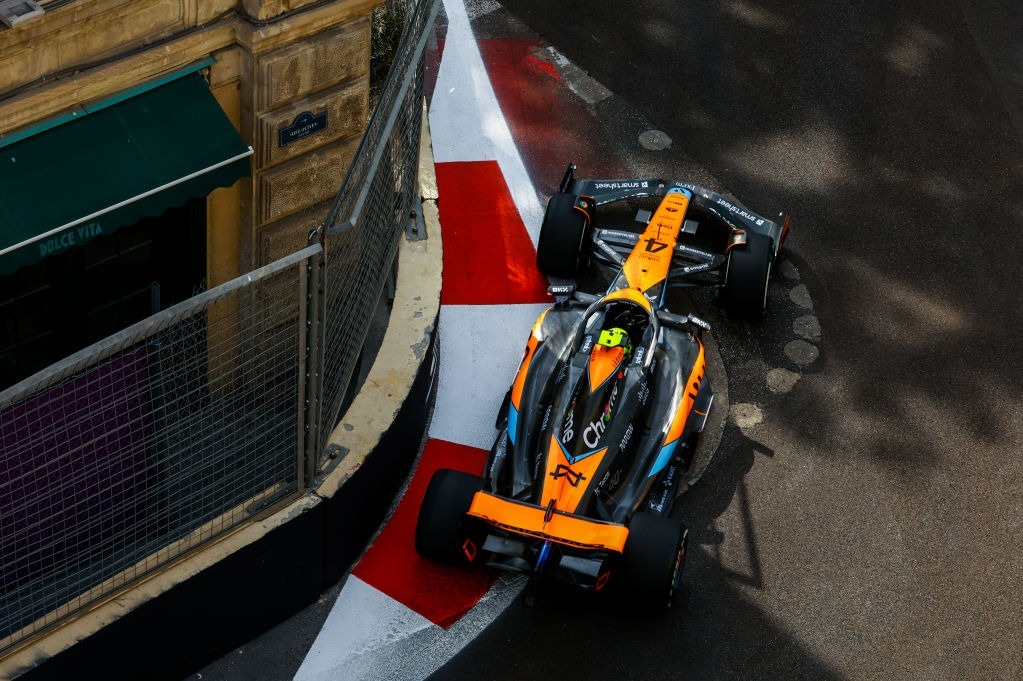
For the 2023 Azerbaijan GP, round four of the season, McLaren introduced a raft of changes including a new floor. It had been planned since before the car's launch.
Photo by: Getty Images
How new is new? Clearly, homologated structures and hard points such as the monocoque won't actually be replaced for alternative designs, so it would be a stretch to describe the Miami-spec MCL40 as literally all new.
But the aerodynamic surfaces and perhaps even some suspension elements are likely to be very different. And, given the lead times involved in development, this is likely to be the first of many – the convergence process, whereby teams gradually coalesce around the most effective solutions, has barely begun.
The pace of 2026 development has been dictated not so much by the budget cap and restrictions on aerodynamic research, but by the very short off-season which preceded what is the biggest change to the technical regulations in decades. That, along with the short period between testing and the opening trio of flyaway races, placed the onus on getting a working mechanical platform ready to run.
Where the budget cap will have had an impact, now logistics form part of the regime, is to steer teams towards introducing larger development steps at defined points rather than air-freighting new parts, especially to far-flung destinations. The exception would be smaller components of the low-hanging-fruit variety, which could be carried by personnel in their luggage.
Given the many unknowns ahead of this season, while all the teams will have had a development plan in place, there was an awareness that the learning curve for each car would be that much steeper. Partly this was a factor of the new power unit package, but in terms of aerodynamics and suspension kinematics, the new straightline mode presented some of the biggest challenges.
The transition between straightline mode and cornering mode changes the aerodynamic centre of pressure, which brings a host of interconnected second-order effects on car balance, ride height, and sensitivity to locking the front and/or rear brakes. It has proved incredibly difficult to simulate accurately, so teams had to wait until they could run their cars on track to begin to develop a proper understanding of what was happening.

Norris took his maiden GP win in Miami in 2024, following a transformative changing including a new floor, sidepods and suspension for his McLaren.
Photo by: Getty Images
Since ride height is one of the key levers teams need to pull to work the underfloor harder for more downforce, the effect of the active aero transition phase plays into a lot of design and set-up decisions. If the ride height is too low, the potential for skid plank wear and disqualification enters the picture.
Equally, drivers crave stability and a compliant front end to give them confidence under braking and turn-in. Under the 2026 regulations, this also feeds into allowing the energy harvesting under braking to be more aggressive.
It's likely the changes up and down the grid will be, for the most part, original, given development lead times and the teams' desire to learn as much as possible about their cars' performance characteristics before committing to a development path. It would be surprising if, for instance, a team arrived with a copy of Audi's unique sidepod configuration, given how integrated this is with the cooling architecture and the mandatory side-impact structures.
This isn't to say teams haven't been looking at each others' solutions since day one of the Barcelona shakedown. They just have to balance the process of understanding their own cars as well as those of their rivals before making judgements about what to copy and what to discard.
Lead times remain a factor here, although having an entire month without racing could provide the "streamlining" effect to which Stella alluded. Chief technical officer Rob Marshall, present in the same press conference, pointed out while copying other teams' innovations may not provide an immediate performance uplift, sometimes it does.
"We look at everything," he said. "Some things are closed off to us quite quickly when you look at the regulations, others remain open, others are limited to by other architectural changes you may have made by things to do with the engine, but ultimately we do analyse everything to a certain extent.

F1 is quite the copycat championship
Photo by: Mark Sutton / Motorsport Images
"Some things go as far as being wind tunnel tested or CFD tested, others are more kind of thought experiments we do on them to see whether we think that would be good or bad for us. But bottom line is we do look at pretty much everything the opposition do up and down the grid and try and assess whether those things would work on our cars.
"It's a sort of common phrase in Formula 1 that copying stuff doesn't work because what works on one car doesn't work on another, but actually that's not necessarily true. Some things work on other people's cars – remember with double diffusers, it worked on one person's car and everyone copied it and it worked on theirs as well.
"So some things are true up to a certain extent. I think copying has always been part of Formula 1. One thing is copying and the other is actually trying to understand what's going on, what the other team are trying to achieve with what they've done.
"And that's kind of where the real trigger is – because you can copy what someone's got but actually you don't have their understanding. If you research it properly, hopefully you develop the same sort of background IP as they had or they've developed, but you're able to develop that quicker because you've been inspired by them."
Fundamentally what McLaren is chasing is more downforce – or, to put it more precisely, more efficient downforce, which is where Mercedes has had an advantage through the opening races of the season. Under the new regulations this advantage has unlocked further performance benefits, since it opens greater opportunities for more efficient energy harvesting in key corners, something which has been obvious from Australia onwards.
The question, then, is who can move fastest in the development race raging away from the track.
We want to hear from you!
Let us know what you would like to see from us in the future.
- The Autosport.com Team