


F1's new V8 engine agreed – five things you need to know
 Originally published by The Race
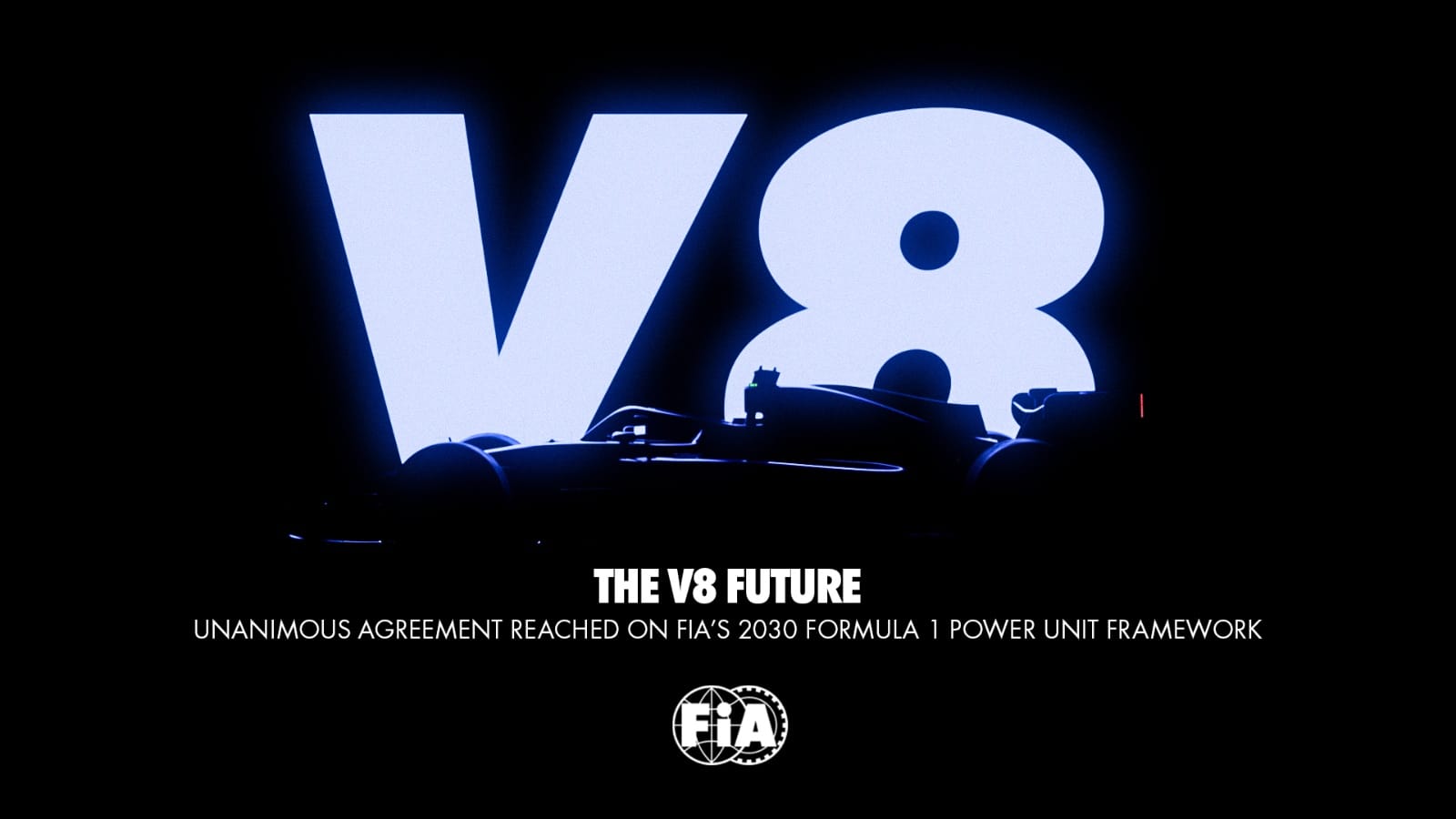
Formula 1 will adopt V8 engines in 2030 now key stakeholders have unanimously agreed on the key details that will underpin the new regulations.
A framework has been unanimously agreed by the FIA, Formula 1, the teams and the engine manufacturers to bring in a 2.1-litre, turbocharged V8 with a reduced electric element.
This switch will be made one year earlier than planned, bringing an early end to the V6 turbo-hybrid rules that only started a controversial new era this season with a switch to a near 50-50 split between internal combustion and electric power.
The FIA World Motor Sport Council will rubber-stamp the plan at a Shanghai meeting next month.
How key final progress was reached
A meeting of the F1 Commission on Monday, November 16 led to agreement in principle over the framework.
But it required some final progress to be made for the engine manufacturers themselves to accept ending the current rules cycle in 2029 and be satisfied with the switch.
The manufacturers are Mercedes, Ferrari, Red Bull/Ford, Audi Honda and future engine supplier General Motors - which was aiming to belatedly join the current rules cycle before the end of the decade (more on that shortly).
After the Commission, a meeting with the manufacturers – which are represented in the Commission but have their own key discussion group with the other stakeholders – went through key feedback to resolve what was necessary to push the proposal to the next stage.
This is what facilitated Friday's announcement of unanimous agreement of the technical framework.
GM will delay engine to fit
A key consequence of the change of timeline is what it means for GM’s plans.
Its Cadillac team, which GM is a minority owner of alongside TWG Motorsports, joined the grid this year as a Ferrari customer on the condition it becomes a full works entry.
GM had been planning to debut that engine built to the current rules in 2029, which it was willing to accept even though it would be only two seasons before all-new rules came in as originally planned.
To accommodate the next rules era starting earlier, though, GM will delay its manufacturer debut so it does not have to design and build a V6 for one season only.
It is expected to remain a Ferrari customer for an extra year and the rules being agreed is well timed as the purpose-built GM engine facility opens in mid-December this year, which means the full might of its development push can be devoted to the new 2030 rules instead of a split project.
"For a period of time, we were working on both,” TWG boss Dan Towriss said in Las Vegas. “So, they've already got a V6 base to build off of, and working towards the V8. There are a number of designs that are in motion now.”
The key details
Officially, the proposed 2030 engine will be a 2.1-litre turbo V8 that carries over “some geometrical specifics”, will feature limited hybridisation” as well as sustainable fuels, and be married to a lighter chassis.
This is all part of the plan to make the engines simpler, cheaper and louder – although the extent of that last point is still unclear given it will not be a normally aspirated engine.
“I look at the old videos of the old engines, they give me goosebumps – it's just that high-pitch squeal that I'm missing from this era,” said Mercedes driver George Russell.
McLaren’s Oscar Piastri cautioned “I don't know if they'll be exactly like the V8 engines that I grew up watching, necessarily”, but added “I think it's firstly great that we've been listened to”.
The turbocharger stays partly to satisfy manufacturer demand but also to assist with fuel efficiency, avoid larger tanks and more fuel usage at the start of races.
This also helps with the stated aim of making the car and engine around 80kg lighter with almost half of that coming on the engine side.
More details of this will surely come from the “detailed regulatory framework” that will go to the WMSC in Shanghai next month.
However, it does appear to represent a satisfactory compromise between what some manufacturers want in terms of hybridisation and FIA president Mohammed Ben Sulayem’s initial desire for an even bigger, loud engine without a turbo.
“The return of V8 engines represents an opportunity to reconnect with the DNA of this championship, bringing back the sound, emotion and pure racing that is loved worldwide,” said Ben Sulayem.
“Our vision is clear, lighter, simpler and more affordable cars that put driver skill at the heart of the competition.”
What’s still to be confirmed
The FIA did not specify the hybrid element, which has been known for some time to be heading towards a 100kW base electric power contribution with an extra 100kW available as effectively a push-to-pass overtaking aid.
It will give the engine more than 1,000bhp at full power but crucially, compared to the current engines, not be dependent on the electric element and therefore not at the mercy of the energy limitations that have dogged the 2026 rules since their debut.
Why the hybrid element has not been exactly specified is unclear – “maybe it have some KERS or stuff like that”, as Alpine boss Flavio Briatore put it – but it stands to reason that this is being delayed until more detail can be shared about how it will work.
With the 2026 rules, the engine regulations were designed first, then the chassis and sporting regulations were contorted around them - leading to a fundamentally compromised product, all because the engine rules had to be set early to get all the targeted manufacturers committed.
This time the core V8 engine plan should be much simpler to align with the car design and operation, but there are still elements to decide - like exactly how a push-to-pass system should be managed and whether the active aero with movable front and rear wings is worth retaining when that was primarily adopted to assist with making the current cars more efficient on the straights.
Drivers are excited - with minor caveats
Every single driver on the F1 grid has, publicly or privately, expressed their displeasure with the 2026 engines and their consequences.
So, unsurprisingly, all who have been asked about the return of V8s have welcomed the plan - from the general concept to the fact that there was a good degree of consultation with the drivers themselves.
Red Bull’s Isack Hadjar said he was very excited for a “full attack racing car” and went as far as adding “I don't see why that would not be the most fun cars of all time in 2030”.
His team-mate, four-time world champion and vocal 2026 rules critic Max Verstappen, indicated he would have liked it to go further though.
"If it's fully up to me, of course you go back to like a V10 or whatever,” he said. “That sounds even better, but I know that that's not something realistic.
“So this is good, this is for sure in the right direction."
Seven-time world champion Lewis Hamilton’s own caveat related to the detail of the as-yet undefined regulations that will define how the engines actually work – although what he hopes for most should naturally be achieved simply by stripping back the electric side so much.
“It's all good and well going to V8, it depends on how they design it, regulation wise,” he said.
“And going back to the good sound because that's I think been lacking since we've been in the V6 era. Bring back the smaller exhaust and get that sound back.
“And as long as we don't have the engine dying halfway down the straight, then I think that will be better.”