
Williams expect energy and tyre management challenge in Montreal Formula 1 Sprint weekend
 Originally published by Grandprix247.com
Williams F1 Team believe Formula 1’s return to Montreal will place a heavy emphasis on energy deployment, tyre preparation and braking stability as teams prepare for the first Sprint weekend ever held at the Circuit Gilles Villeneuve.
Ahead of the Canadian Grand Prix, Williams Chief Trackside Engineer Paul Williams outlined the major technical factors expected to shape the weekend under the 2026 regulations.
The Grove outfit expects the unusual energy profile of the circuit to create fresh complications for teams already adapting to Formula 1’s revised hybrid systems.
Williams explained: “Montreal’s circuit layout poses unique energy challenges. The ‘asymmetric’ energy demand, with low usage in the first half and high usage in the second, creates a new challenge for the team.”
The Canadian venue remains one of the calendar’s most power-sensitive tracks, with long straights broken up by heavy braking zones and slow corners demanding strong traction and efficient energy deployment.
The Williams engineer said: “Power and efficiency are paramount. The series of straights separated by low-speed corners places a premium on power unit performance, aerodynamic efficiency, and total downforce.”
The third Sprint event of the season also adds another layer of complexity because teams will have only one practice session before Sprint qualifying begins.
Williams noted: “The third of six Sprint events and the first in Montreal creates an additional challenge, with only a single practice session ahead of Sprint qualifying.”
Tyre preparation expected to be decisive
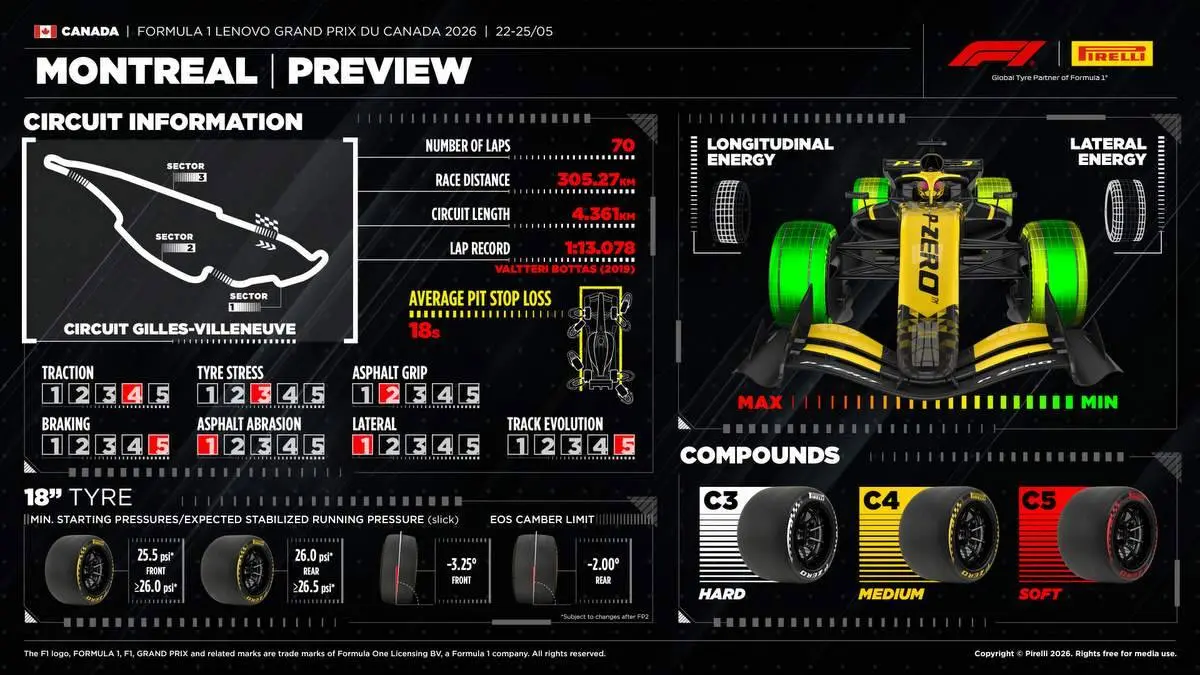
Williams expect tyre warm-up to become one of the defining themes of the weekend, particularly if cool Canadian conditions persist.
The team highlighted that Pirelli’s harder compound allocation compared to 2025 could increase the risk of graining on both the soft and medium compounds.
Williams explained: “Tyre preparation is one of the hardest of the year. The short, smooth, low-energy track combined with likely cool conditions makes generating tyre temperature extremely difficult, particularly in qualifying where preparation laps may be needed.
“Teams often struggle to get heat into the tyres, particularly the fronts, which affects grip and confidence through the lap," he added.
The smooth track surface and low lateral loads mean degradation is not expected to become a major thermal issue unless graining develops.
Williams said: “The softest tyre allocations are paired with a circuit that generates low lateral energy, meaning degradation is typically rear-left wear limited rather than thermal, provided graining is kept under control.”
Safety Cars could define strategy

Williams expect strategic flexibility to become critical because of Montreal’s traditionally high intervention rate.
The team estimates a 70% probability of a Safety Car and a 44% chance of a Virtual Safety Car during the Grand Prix.
Williams explained: “Early intervention will promote very long second stints, whilst late intervention could trigger extra pit stops.”
The short lap also opens multiple qualifying approaches as teams weigh tyre preparation against traffic management.
Williams said: “The short lap allows many permissible run plans mixing 1-lap and 3-4 lap runs, with the key trade-off being optimal tyre preparation versus traffic management.”
For the Sprint race, Williams expect a straightforward medium-tyre run to be the preferred strategy.
Williams noted: “Montreal’s first ever Sprint event is expected to be a zero-stop race, with the medium compound holding a marginal 0.1 place advantage over the hard.”
For Sunday’s Grand Prix, the team believes a medium-to-hard one-stop strategy remains the strongest option.
Williams concluded: “Grand Prix favours a one-stop medium-to-hard strategy. Two-stop races are approximately one place worse, and race pace is significantly more rewarding than qualifying pace, placing a premium on Sunday performance.”