
Hamilton's real Barcelona pace advantage explained
 Originally published by The Race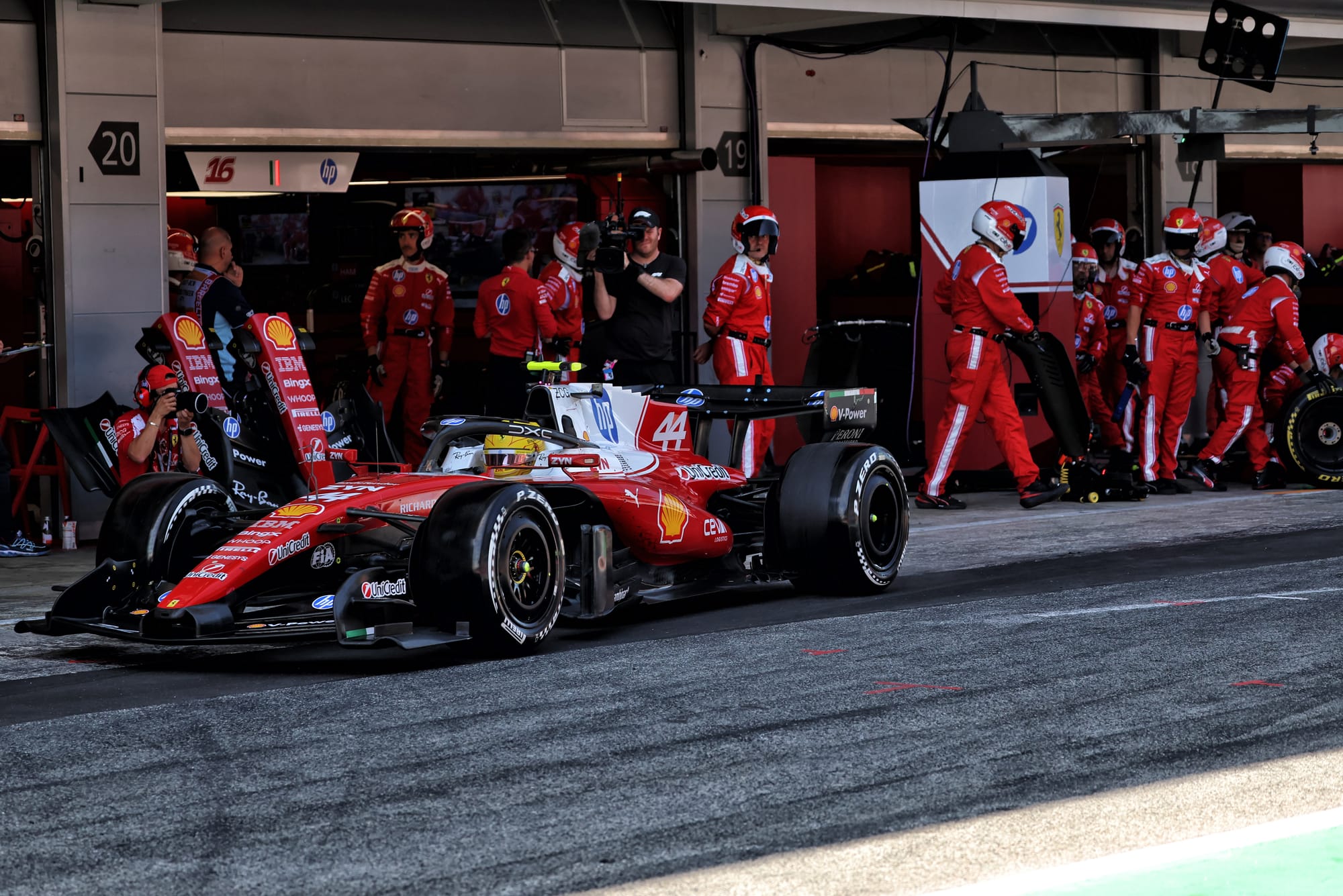
There is little doubt that Lewis Hamilton received a big helping hand in his charge to victory in Formula 1's Barcelona Grand Prix with the late-race virtual safety car.
But was the VSC a single element stroke of luck that effectively won the race and derailed any hope for Mercedes? Or would Hamilton have still triumphed without it?
That is something that nobody can be totally sure about, but there are some pointers that give us a good indication of what would have likely happened.
The VSC opportunity
Fernando Alonso's stoppage in his Aston Martin on lap 40 of 66, which brought out the VSC at a near perfect time for Ferrari, meant Hamilton's 17.963-second buffer at the front was enough to allow him to execute his final stop without losing track position.
With clear air and fresh tyres, the seven-time champion charged clear of the pursuing Mercedes to end up with the biggest winning margin of the F1 season so far.
Winning margins 2026
Australian GP: George Russell 2.974s
Chinese GP: Kimi Antonelli 5.515s
Japanese GP: Antonelli 13.722s
Miami GP: Antonelli 3.264s
Canadian GP: Antonelli 10.768s
Monaco GP: Antonelli 6.271s
Barcelona GP: Hamilton 19.561s
The 19.561s lead that he had over George Russell by the time they reached the chequered flag would appear on the face of it to show that Hamilton was in a class of his own and had a scale of pace advantage that would have meant he would have won without the VSC at all.
But what is important to understand is that Barcelona was an abnormal race in terms of tyre degradation and temperatures being so high, so there were pace illusions caused by tyre life offsets.
It was a race where those on the pitwall quickly realised that the pace of everyone was decided much more by strategy than the actual cars themselves.
Post-race data analysis points to the tyre degradation being pitched at 0.15s per lap.
So in simple terms, if you stopped a lap later than another car, you would then be 0.15s quicker than them from tyres alone. Stop 10 laps later, and you rejoin with a 1.5s pace advantage – every lap!
Based on this data, we are able to tyre correct the pace of the cars to show that the difference between Hamilton and the Mercedes (excluding the rubber) was much smaller than it appears at the end of the race.
Mercedes had, after all, successfully covered Hamilton at the first rounds of stops (Hamilton pitted on lap 11 and Russell on lap 12), and then their strategies diverged at the second stop as Ferrari committed to the three-stop strategy.
After Hamilton pitted on 27, he enjoyed a fresh tyre advantage until lap 36 when Russell came in, one lap ahead of Antonelli.
With there being a nine-lap tyre offset (and don't forget Pirelli's analysis suggested that there was little pace difference between the different compounds) Hamilton was able to peg back what should have been a 1.35s per lap advance from behind to around half that.
When he stopped on lap 41 under the VSC, that left him with tyres that were five laps fresher than Russell and four laps fresher than Antonelli as he emerged with a 2.939s gap to second place.
Based on the degradation difference, Hamilton should then have had a 0.75s per lap advantage over Russell on pure tyre pace alone irrespective of car performances.
Tracking his laps until the end of the race, it shows that over the remainder of the race as he pulled out the gap to 19.562, not all of his laps were in excess of this (Hamilton varies between 0.3s and 1.2s faster) – but he was helped a lot by Russell and Antonelli fighting behind him.
Mercedes also revealed on Monday night that Russell was compromised in his final stint by unexpected oversteer as a front wing adjustment at his last stop went wrong due to a problem with the adjustor gun.
As an average from lap 43 to lap 62, when the VSC was called for Antonelli's stricken car, Hamilton's average pace advantage was 0.849s – showing that the actual car pace advantage was there but not as big as it may have appeared.
That still means the pace was surely there to win it whatever happened?
Well, there are some caveats in coming to this conclusion.
Hamilton's three-stop pace was flattered by his final stint taking place in completely clean air. There was no excess stress on his tyres from pushing harder than he needed to, from being in the dirty air of other cars or from needing to drive more aggressively to overtake others.
Pirelli's chief engineer Simone Berra reckons "doubt remains" over whether Hamilton's three-stop strategy would've given him the pace to win regardless of the VSC.
"With the three stops, the risk is to finish in traffic. On paper, in free air, three stops is faster, that's clear," Berra explained.
"But to overtake three drivers, and fast drivers like [Lando] Norris, Antonelli and Russell, would have been a different story."
There is also an element that had Hamilton stopped under normal conditions and dropped behind the Russell/Antonelli/Norris train before charging back up to it, that could have prompted a change of tactics from Mercedes too.
Aware that Antonelli's tyre degradation seemed to be better than Russell's and gave him a pace advantage (estimated to be 0.3s per lap in total), Mercedes' reluctance to interfere in the title battle may have been pushed aside if it was faced with the choice of deploying team orders to ensure victory or avoiding them and definitely losing the race.
Had it inverted positions and allowed Antonelli the freedom to try to build a buffer at the front, that could have given Hamilton a tougher task in getting on terms with him.
And then we are in the realms of a lot of what ifs in terms over whether Hamilton have had the pace to catch and overtake Antonelli (tyre offset suggests so), and if not would Antonelli have retired anyway, and also there was the matter of the impact of his post-race five second penalty...
The consensus
While nobody can know for definite about the turn of events if the VSC had not come about, the consensus from both Mercedes and Ferrari was that Hamilton was still most likely set to win – but that it would have been mighty close.
Toto Wolff's conclusion was: "Lewis was the quickest afterwards, so even if we would have come out in front of him, it would have been very tricky to hold him behind."
Ferrari team principal Fred Vasseur had his own idea about the outcome
"We would have won the race, perhaps with a bit less," he said. "But we were also in a good situation with a fresh set of tyres at this stage, and it was positive for us.
"I don't want to do the calculation of what would have been the race with this or this, but I think we were already in a very good situation."
And while we will never know for sure how things would have panned out, it is understood that Mercedes' post-race analysis gave its own verdict.
It is that Hamilton would not have had an easy time but would have been on target to take the lead with two or three laps to go – ending the race with only a one or two-seconds lead.
This all shows the VSC did not hand Hamilton the win; but it made sure the victory was made a lot more straightforward.