
Lewis Hamilton telemetry reveals how pole slipped away in final metres

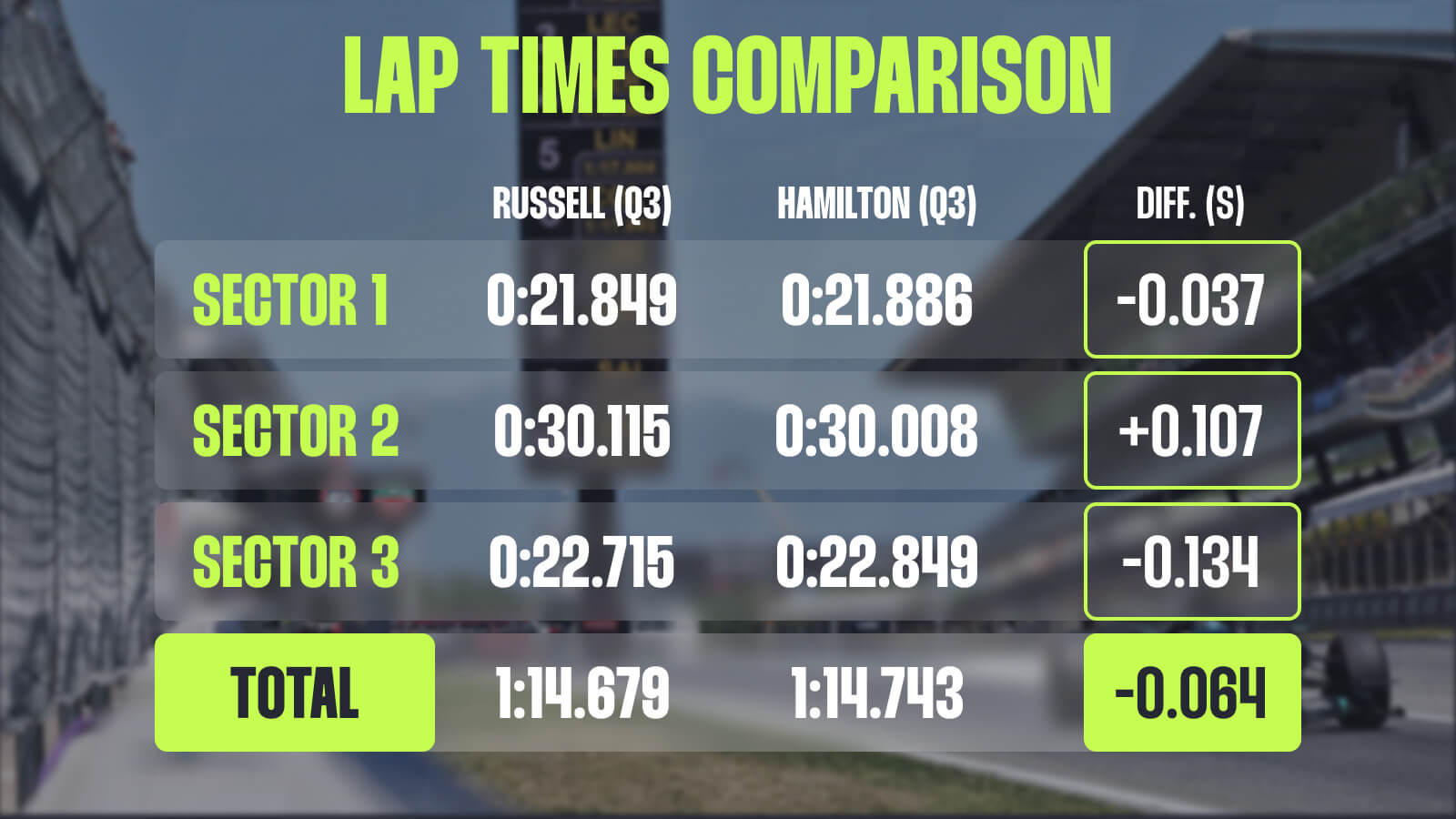
Once again, Lewis Hamilton delivered a mega lap in qualifying to come within a whisker of snatching pole position from the dominant Mercedes, falling short by a mere 0.064 seconds.
However, Hamilton was actually far closer to pole than the final margin suggests, and telemetry data shows exactly why.
Lewis Hamilton telemetry analysis from Barcelona qualifying
Want more PlanetF1.com coverage? Add us as a preferred source on Google to your favourites list for news you can trust
Although Ferrari arrived in Barcelona with a major aerodynamic upgrade package, the practice results indicated that the Maranello team was still too far back to challenge for pole position.
The primary objective of these updates was to generate higher downforce and greater cornering stability – critical traits for the long, sweeping corners of Catalunya and the severe tyre degradation that always characterises this track.
In that regard, the upgrades undoubtedly paid off. Both Ferraris were exceptionally quick through every corner profile, with Mercedes being the only outfit capable of matching them in this department.
However, their primary Achilles’ heel remains a power unit deficit, which causes Hamilton and Leclerc to bleed significant lap time on the straights. In fact, their time losses came exclusively from straight-line speed. Because of this, McLaren looked like the only team capable of threatening Mercedes, right up until Lewis Hamilton’s final flying lap.
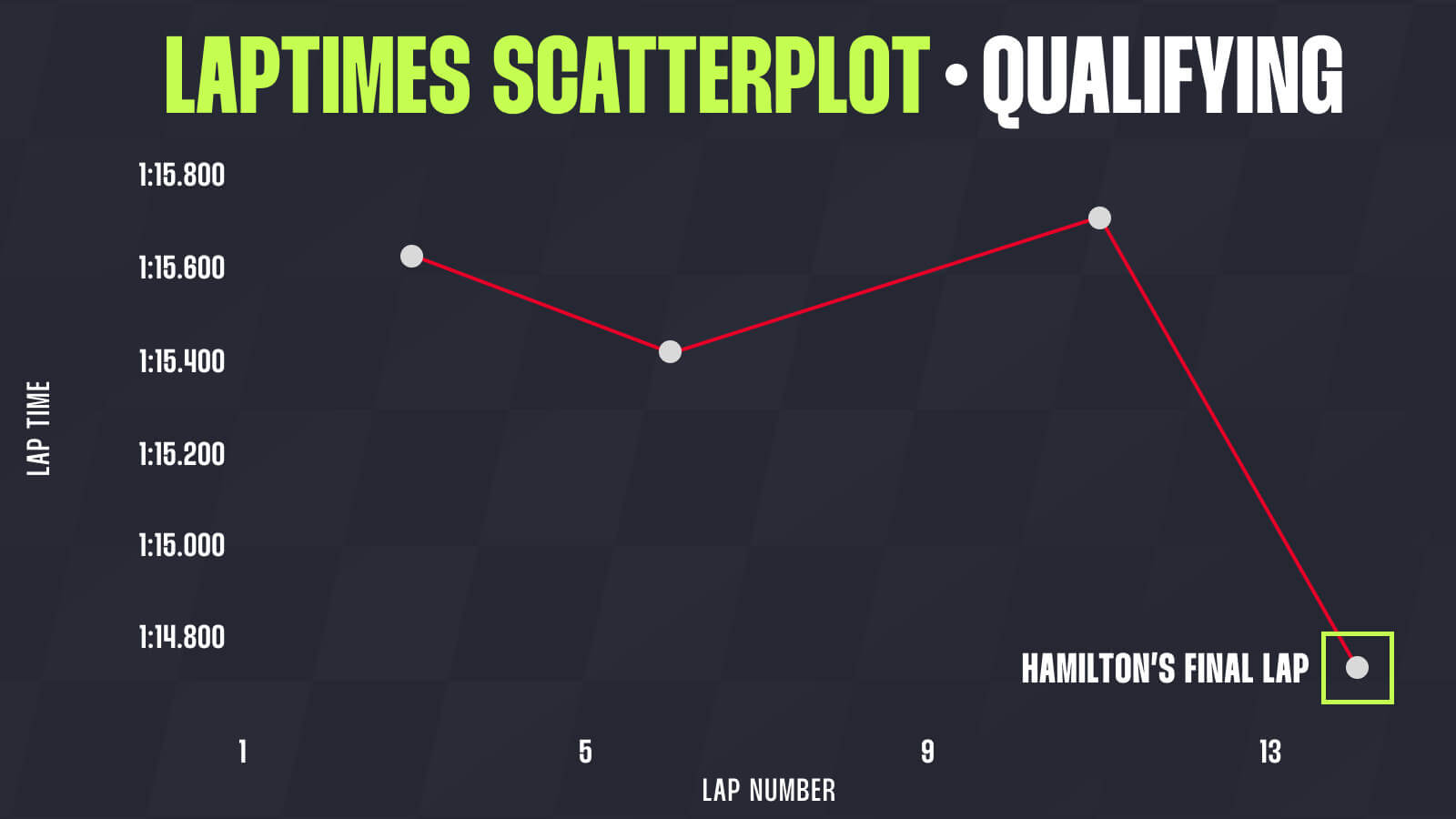
Just how impressive the British driver’s lap was is best illustrated by the graph below, which showcases all of his flying runs from the qualifying session:
If we take a closer look at a direct telemetry comparison between Hamilton and Russell, we can see that the seven-time world champion was actually faster across almost the entire lap.
Lewis gains his biggest advantage in Turn 4, where he carries a 5 km/h higher minimum speed through the apex. This immediately hands him a tenth of a second, a margin he manages to preserve all the way to the final corner of the track.
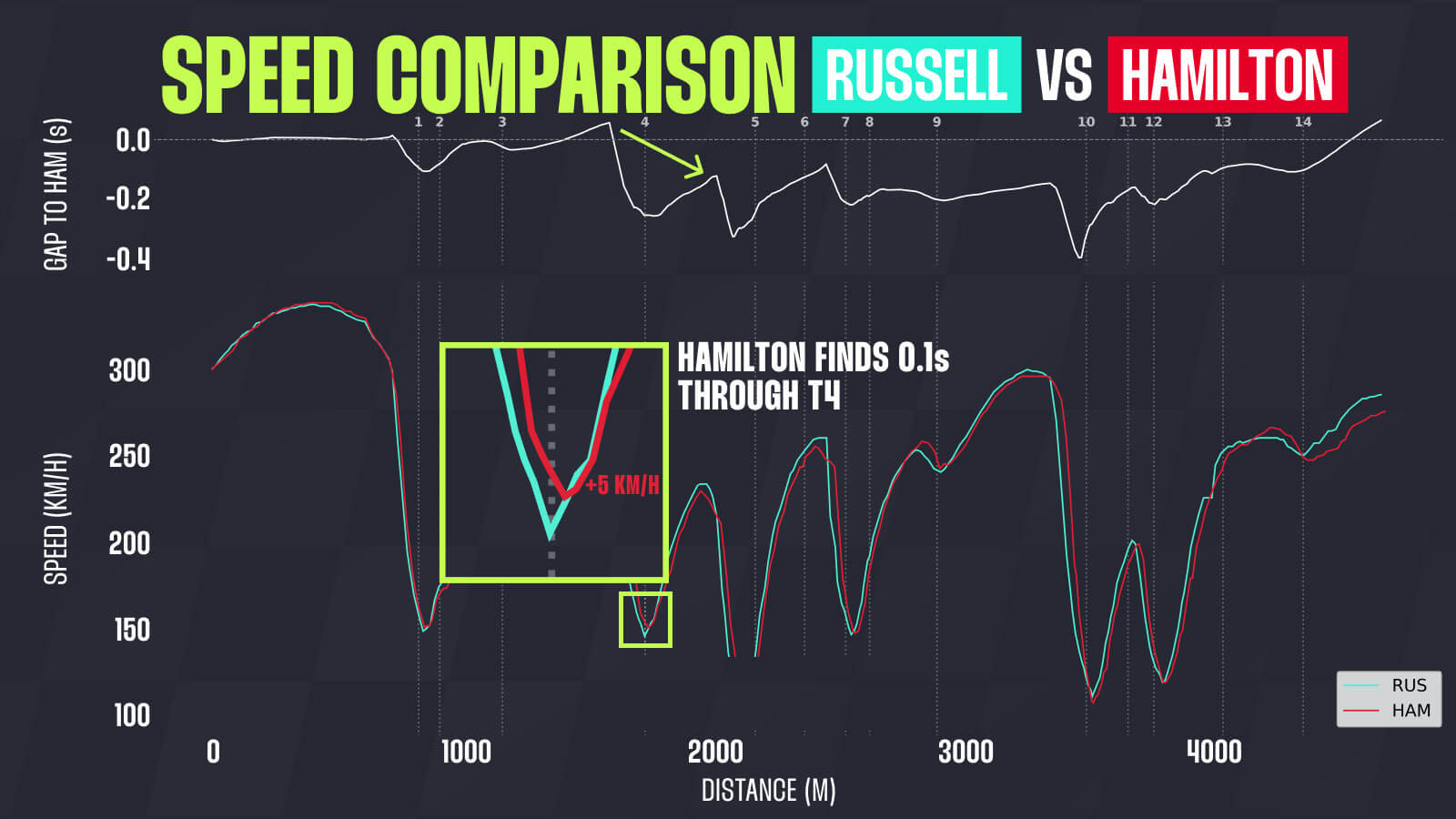
In fact, Lewis delivered a mega middle sector, the fastest of anyone on track, despite having to deploy a lift-and-coast tactic entering Turn 5 and Turn 7. This management strategy was visible during free practice for both Ferrari drivers and served as an attempt to mask their power unit deficit.
By lifting early, they harvested energy into the hybrid battery to deploy later along the straight between Turn 9 and Turn 10. This was the only straight section where Ferrari managed to match Mercedes stride for stride.
The breaking point came at the final corner, where Russell’s superior traction and exit drive snatched pole position right out of Hamilton’s grasp. The graph below illustrates just how much more strongly the W17 accelerates and how rapidly it claws back the delta time.
Russell only edged ahead roughly 100 metres before the timing line.
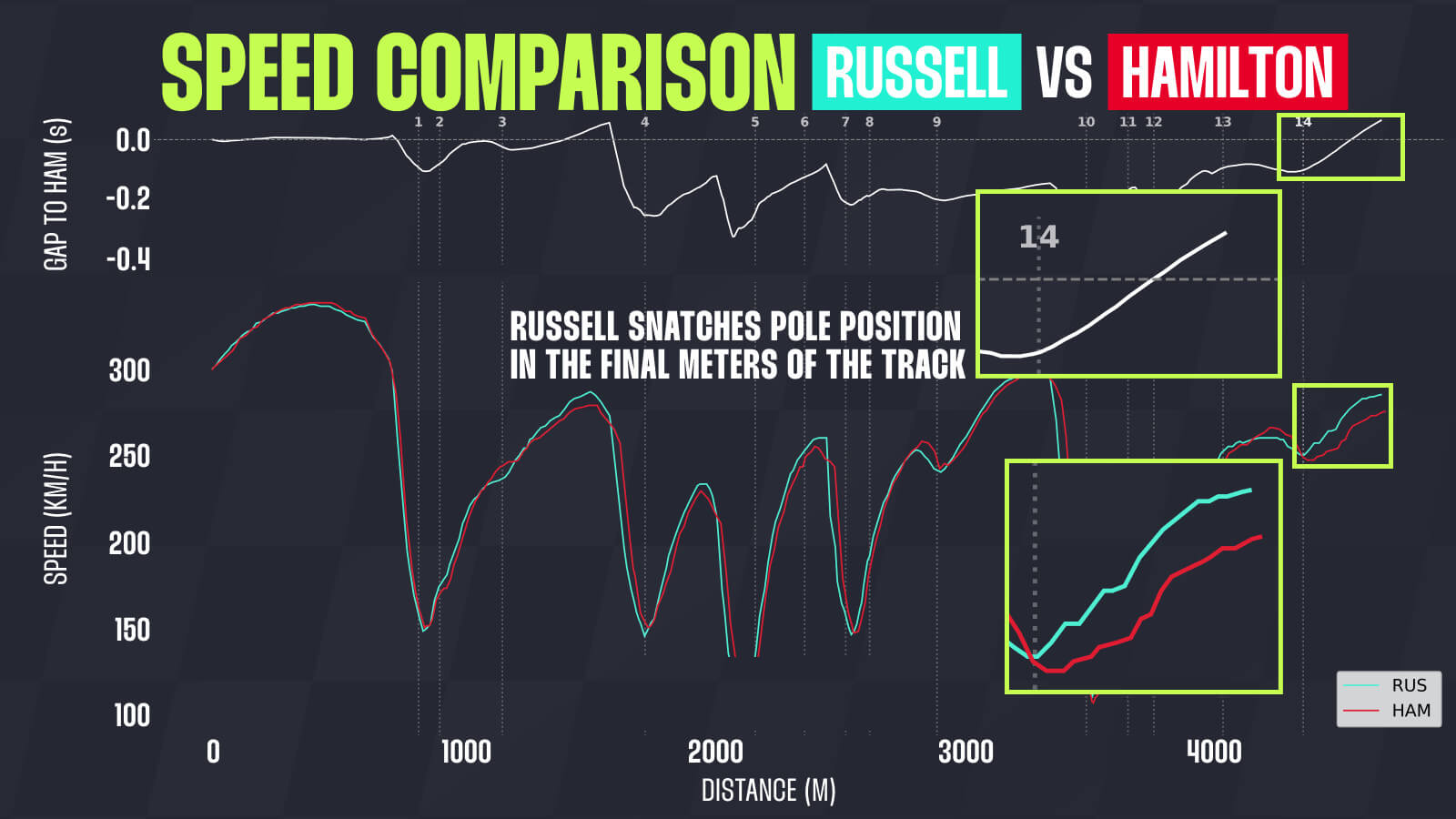
The data shows that George was 0.136 seconds quicker in the final sector, and it is clear that almost this entire deficit was accumulated after Turn 14. These are incredibly fine margins and represent masterful driving from both competitors, each extracting the absolute maximum from their respective machinery.
More from qualifying at the Barcelona Grand Prix
George Russell ends Kimi Antonelli’s pole streak with Barcelona P1
F1 starting grid: Russell on pole as Barcelona GP grid order forms
What to expect from Lewis Hamilton in the race?
For the first time in a while, we were treated to proper race pace simulations during Friday’s FP2 session. As expected, Mercedes enters Sunday as the clear favourite. They logged the strongest long-run pace on the medium compound, and on raw race rhythm, it is highly unlikely anyone will be able to challenge Russell.
The leading non-Mercedes runner behind him was Leclerc, who also demonstrated strong pace on the mediums. Hamilton, by contrast, trailed Leclerc’s average long-run time by around nine-tenths of a second.
Naturally, this isn’t the true delta we will witness during the Grand Prix, but it remains a fact that Leclerc extracted greater long-run potential. Crucially, however, Leclerc starts down in P10 and will have to contend with traffic and dirty air. Hamilton faces no such hurdles.
Furthermore, Ferrari has hardly shone when it comes to tyre degradation so far this season, particularly regarding rear-axle thermal management, which could pose a severe threat here. We are almost certainly looking at a two-stop strategy, with the field likely to lean aggressively towards the undercut, given that it is highly effective on high-degradation circuits.
As we can see, numerous variables will come into play in Barcelona, making concrete predictions difficult. What is certain, however, is that Mercedes holds a clear edge, leaving the rest of the field to fight for the scraps.
Want to be the first to know exclusive information from the F1 paddock? Join our broadcast channel on WhatsApp to get the scoop on the latest developments from our team of accredited journalists.
You can also subscribe to the PlanetF1 YouTube channel for exclusive features, hear from our paddock journalists with stories from the heart of Formula 1 and much more!
Read next: Russell rebounds as Leclerc suffers: Barcelona qualifying winners and losers