
McLaren has lost a core advantage of its title-winning F1 cars
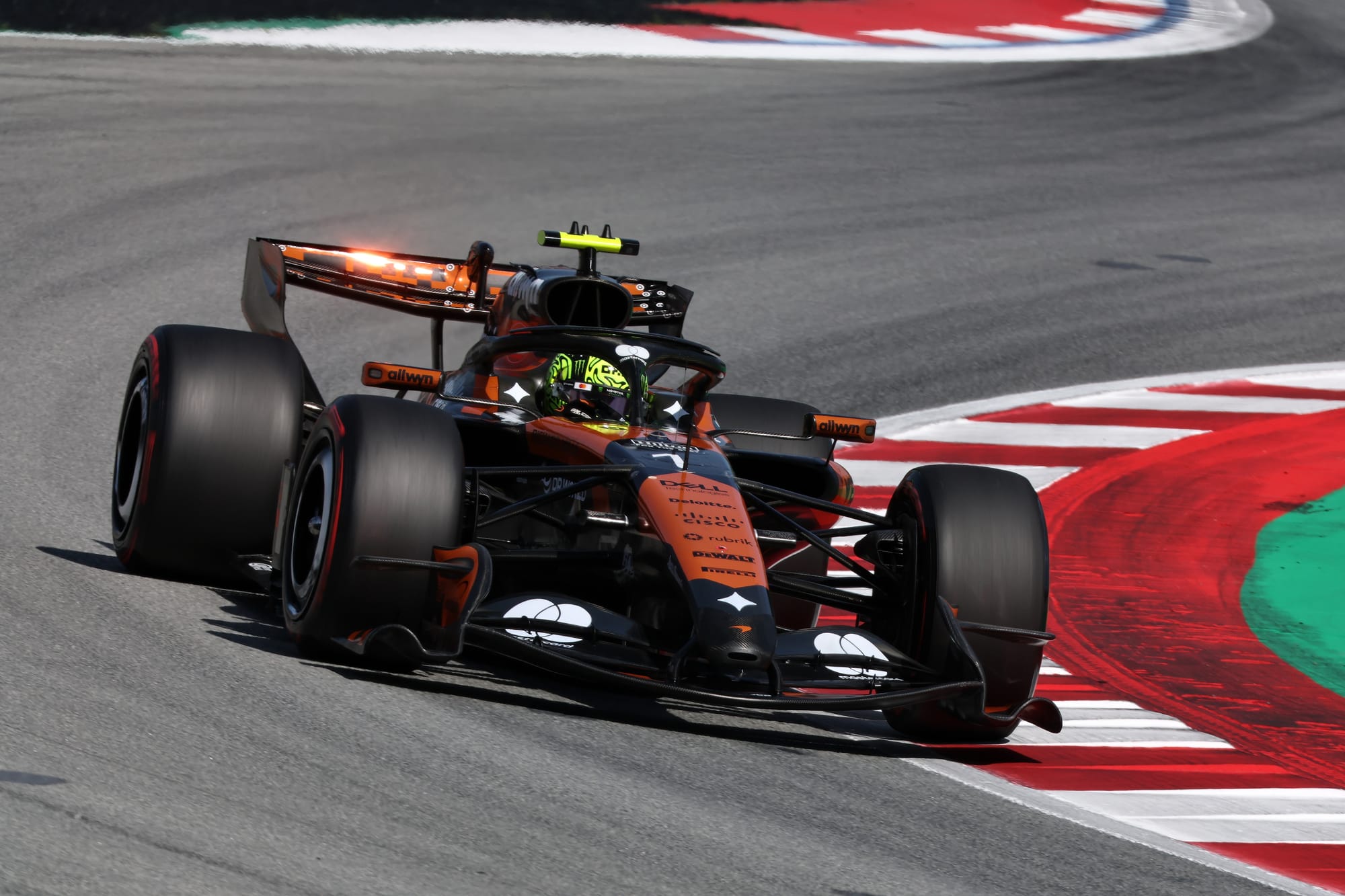
McLaren believes that one of the standout car characteristics that helped it to Formula 1 title glory last year has not been carried over to its 2026 challenger.
Lando Norris was helped on his way to the drivers’ championship in 2025 by McLaren’s impressive tyre temperature management, with the squad having a clear edge in this area over its competitors.
Such was its advantage in controlling degradation, especially on the rear axle, that it even prompted conspiracies from rivals about it having employed some strange tricks, which included wild theories about tyre water that proved to be incorrect.
But ahead of a Barcelona Grand Prix that is going to put a premium on the thermal management of tyres that McLaren was so good at last year, the team concedes that its edge here has gone.
Norris reckoned that McLaren was certainly not the class leader any more, with championship leaders Mercedes setting the benchmark now.
“I don't think we're as good on tyre deg as Mercedes,” said Norris. “I think they're probably the leaders in tyre deg. I think we're good compared to others, but also the Ferrari is incredible in the corners.”
McLaren team boss Andrea Stella believes that temperature control, both in getting tyres into the right operating window as well as them not getting above it, is not as in hand as 12 months ago.
“We know at McLaren that we have some opportunities to do better,” he said.
“We have margin still to design our car to make sure that the tyres operate in the right range, in conditions that can span from the [cold] Sunday in Canada, where we were not very competitive, and mostly because of tyre temperature.
“In the very hot conditions that we are finding here in Barcelona, we are not as competitive as we were in 2025, in terms of tyre conditioning and tyre degradation.
“It’s a very clear objective for development. We will see where we effectively are, but based on what we have seen in practice, we don't seem to be having any particular advantage from this point of view.”
New rules, new concept
While McLaren’s previous efforts to get on top of tyre temperature management meant it had a good fundamental understanding of the dynamics at play, Stella thinks that the design overhaul for this year has meant it has been unable to deploy things as much as it wants.
A host of factors have contributed to this, including a reduction in downforce and smaller tyres (which means the rubber slides more), and a whole new brake cooling regime at the rear of the car because of the increased harvesting demands, which means internal cooling demands are totally different.
But Stella says there were also some concept directions that McLaren took that meant it had to sacrifice some of the tyre cooling gains.
“There were some aspects of the design that we wanted to, let's say, reset for reasons that have not only to do with the tyres, but there are some other parameters from a design point of view,” he said.
“Now we are gradually evolving towards what we think is the right thing to do for the tyres. So it's a bit of a reset that we were kind of forced to take, as we designed a completely new car, which created some extra demands.
“We needed to meet all these demands in a single go to start a new project. Now we are starting with the development and fine-tuning in the areas where most opportunities exist.
“So I don't think, from a tyres point of view, there's a big difference in terms of what the tyres need.
"There might have been a little bit of a shift because the tyres are smaller, but it's more that we need to design the car to respond to the tyre demand rather than the demand of the tyres has changed dramatically.”
No place to hide
The situation has left Norris and Oscar Piastri well aware that the opportunities to take the fight to Ferrari and Mercedes in the Barcelona GP are going to be limited.
Piastri said: “It's going to be tough. We felt like maybe we could get close to Mercedes over one lap, or certainly be able to challenge for the front row or top three, but over a race distance you don't really have anywhere to hide.”
Norris said that with Mercedes and Ferrari having a pace advantage, they would be better able to manage things in a race that is on the edge between a two-stopper and a three-stopper.
Norris said: “They can drive three tenths slower, looking after the tyres, and still be quicker than us.
“I need to push an extra tenth, then overheat the tyres to push more than them to try and get past them. So I think it's a race where you don't want to be overpushing.”