
The key lesson F1 has learned ahead of the next rule change
 Originally published by Motorsport.com
During the enforced break caused by the cancellation of the Bahrain and Saudi Arabian Grands Prix, a series of high-level meetings are taking place to discuss potential changes to the Formula 1 rules introduced only this year.
It's not unheard of for the rules to be adjusted in-season. And in the case of the new regulations, there was broad agreement among the stakeholders and the teams that the shift to greater electrification involved a learning process which would lead to tweaks at some point.
But what's certain is that the audience response to the new technical package has been more polarised than expected. While the stakeholders and many insiders feel the new style of racing has been positively received for the most part, it’s undeniable that a constituency of fandom doesn’t like it – and is expressing its dissatisfaction vocally.
The root of the problem is that shift to a near-50/50 mix of power from the internal combustion engine and electrical motor. This was agreed as long ago as August 2022, in a meeting of the FIA's World Motor Sport Council, where it was also decided that F1 would shift to 100% sustainable fuel and drop the MGU-H hybrid element.
When these policies were rubber-stamped, F1's stakeholders were keen to keep the power unit manufacturers engaged – and potentially attract new ones – by following the wider automotive industry's direction of travel. At the time this was very much towards full electrification, given impending legislation against the sale of internal combustion-powered cars in many key markets.
In the interim between agreeing this principle and executing it, the mainstream automobile manufacturers have altered trajectory as idealism has crashed upon the rocks of realism. It's very easy for politicians and bureaucrats to sit in meetings and decide on timescales for phasing out the internal combustion engines, but rather more challenging to impose that will on consumers.
As a result, F1 finds itself having to make the best of a fundamentally flawed concept – while the car manufacturers who influenced it put the brakes on their shift to full electrification.

Watch: Autosport's Exclusive Interview with F1 CEO Stefano Domenicali
"I think we are in a moment, a unique moment, where we don't have to mix mobility and racing," said F1 CEO Stefano Domenicali in an exclusive interview with Motorsport.com.
"But of course, racing is done by teams and manufacturers. And therefore, if you look how quickly the landscape of the manufacturers changed after 'Diesel-gate' [where the VW Group in 2015, followed by other manufacturers, were 'outed' as fitting devices to cheat emissions tests] – and I was at that time in Audi [as CEO] – is impressive.
"If I connect these two elements that should be kept separate, it is true that at that time there was a clear indication from all the manufacturers that either we go in this direction [electrification] or we [i.e. the manufacturers] will not be interested in any sport.
"And I could be even more direct. If we would have had an independent manufacturer, we could have said, 'You know what, OK, let's offer a white-label F1/FIA engine to the teams who want to race, let's go for it.'
"But we didn't. There was no one at that time [to provide an independent engine].
"That's the status of five years ago. Now it's clear that electrification has shifted versus hybridisation. And everyone understands that if sustainable fuel will be there in terms of quantity with the right pricing, it could be the way to be realistically ready to tackle the emission point."
For much of its existence, the world championship has been dependent on manufacturers because very few specialist independents have the resources and budget to develop competitive engines. Even the Cosworth DFV V8, which effectively democratised F1 through the 1970s, would not have been built without vital investment from Ford.

Renault has owned 'Team Enstone' twice and is now understood to be entertaining potential buyers
Photo by: Sam Bagnall / Sutton Images via Getty Images
The manufacturers arguably grew more influential in the late 1990s and early 2000s as the costs of competition grew, and tobacco sponsorship was legislated out of existence. Some even bought teams outright, giving them a voice in policy – for instance, hybrid power entered F1 in the first place because Renault, specifically, made electrification a condition of its continued participation.
It has now shuttered its engine-building facility and is known to be entertaining potential buyers of its team, currently competing under the Alpine brand.
In 2008, when Max Mosley was FIA president, the governing body announced a homologated low-cost powertrain with a V8 engine developed by Cosworth driving through an Xtrac gearbox. The idea was to facilitate the entry of new teams into what would be a budget-capped alternative tier of competition.
Ultimately this attempt to wean F1 off manufacturer dependence did not survive Mosley's exit from power. But there are powerful lessons to be drawn from this and the present state of affairs, where those in authority must chart a delicate diplomatic course between keeping the manufacturers engaged and giving them too much influence.
"What we have learned as a motorsport is, first of all, not to be any more in a corner where we need to be so dependent on the manufacturers," Domenicali said.
"Manufacturers are a vital piece of what we are doing. We need to thank them every day and every night because without them it would be impossible.
"But we cannot be any more in a corner where manufacturers can dictate the pace to the sport. That's a lesson learned that I think that will enable us, together with the FIA that is the regulator, to find the right package that allow the two worlds to live, to co-exist, because we want the manufacturers to be in, with no doubt.
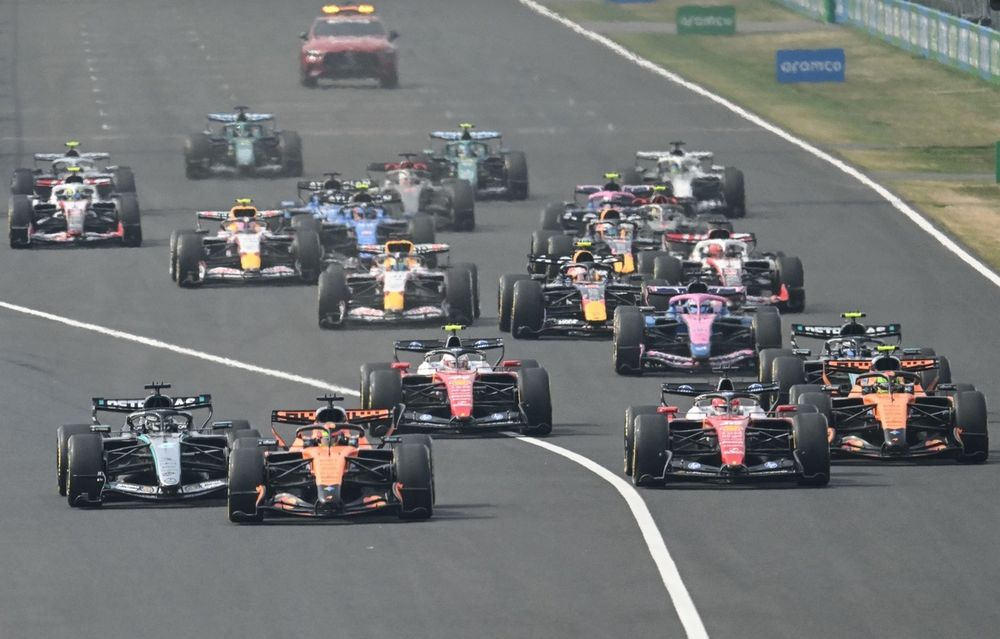
Race start
Photo by: Andrew Caballero-Reynolds / AFP via Getty Images
"But we cannot be put in a sort of a corner that 'take it or leave it'. That's the thing that we need to do in the next couple of years.
"We cannot be in a situation where a crisis of the market can bring certain difficult decisions for the manufacturer to give priority to other initiatives. Therefore, we have to protect [against] that.
"We are living in a world where we cannot take anything for granted. And things can change very quickly.
"The only thing we need to avoid is to be in a sort of situation where we are naked or surprised… I think the only way to do it is to have a sort of framework of regulation that will allow the manufacturer to be respected and be in.
"But in case they decide this platform is not any more attractive for them because of other reasons, not connected to the motorsport itself, we can react and give possibility to the teams to perform and to the business to be as strong as it is today.
"It's up, of course, to the FIA to propose that, a sort of sustainable fuel for sure at the centre of the future, with a different balance of what could be the electrification in the future with a strong internal combustion engine.
"Because that's motorsport. It will allow to save a lot of kilos, to have pure racing in that respect, in terms of a lighter car, smaller cars that you can really push as much as you can."
We want your opinion!
What would you like to see on Motorsport.com?
- The Motorsport.com Team